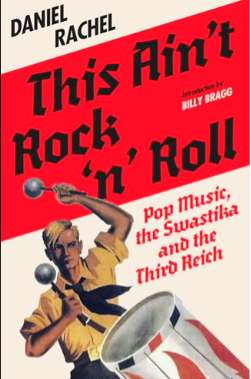
I have just finished reading a very interesting novel called Death in Berlin by Simon Scarrow, and I thoroughly enjoyed it. Set in Berlin in 1940, it follows a Kripo detective and his Jewish girlfriend as they navigate life under the Nazi regime. As I placed it back on the bookshelf, it reminded me that I was supposed to review this book, also about Nazis.
The thing about the Third Reich is that it remains endlessly fascinating to people and, whether we like it or not, it sells. My subscription to History Hit contains no shortage of documentaries covering this relatively narrow period of history. Personally, I do not watch many war films or WWII documentaries because I do not enjoy war. However, I do find the darkness of the era, the extraordinary personalities involved, and the almost hypnotic madness of the regime compelling subjects of study. I have several books on the subject sitting on my shelves, but none of that makes me a Nazi. I repudiate everything the regime stood for. That point is important and one I will return to later.
We do review music books occasionally at Rock The Joint Magazine, and this one immediately caught my attention. The cover alone — featuring a Hitler Youth drummer — catches the passer by. Daniel Rachel understands that the imagery of the Third Reich still provokes curiosity, outrage and debate nearly eighty years after its fall, and that fascination sits at the heart of this book.
The research on display here is impressive, and the book reads like a who’s who of modern popular music. Artists ranging from Lady Gaga to the Sex Pistols, The Beatles, Madness and Queen all appear within its pages. What links them is Rachel’s central argument: that many musicians have, at various points, flirted with imagery, symbolism, language and occasionally even ideas associated with Nazism.
Given that we are living through a period of deep political division, where extreme viewpoints are amplified and opposing opinions are often met with little tolerance, these are controversial waters to navigate. With an introduction by the outspoken left-wing musician Billy Bragg, Daniel Rachel — himself the former lead singer of Rachel’s Basement — sets out to examine and expose the relationship between popular music and the aesthetics of the Third Reich. He does so with intelligence, confidence and a clear sense of purpose.
Sometimes the connections are obvious. Sparks’ This Town Ain’t Big Enough for Both of Us featured visual imagery that included a Hitler-style moustache. The punk movement frequently embraced swastikas and Nazi symbolism as a means of provoking outrage. Siouxsie Sioux (below), while associated with the Sex Pistols‘ circle, famously appeared in Paris wearing little more than a swastika armband. Sid Vicious regularly wore swastika T-shirts, while the Sex Pistols recorded the notorious “Belsen Was a Gas.”
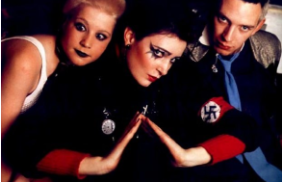
Rachel is careful to remind readers that these were not merely provocative fashion statements. Behind every swastika stood a dictatorship, a genocide and one of history’s greatest atrocities. That point becomes a recurring theme throughout the book.
Punk, however, was only one strand of this strange fascination with the Reich. Lemmy Kilmister, for example, had a well-documented obsession with collecting Nazi memorabilia. As Rachel reminds us, Lemmy once remarked of his home: “It looks like a shrine to Nazism. But it’s just my collection. I mean, you can’t put it all in the cupboard; it won’t fit.” Lemmy frequently wore Iron Crosses and even German military uniforms from the period. Rachel continually returns to the uncomfortable question of what these objects represented and whether it is ever possible to separate them from their historical context. Remember, with Lemmy the crucial point is that he repeatedly denied any sympathy for Nazi ideology. He often pointed out that he collected military artefacts from multiple countries and periods, not just Germany. He also made comments attacking racism and fascism. People who knew him generally describe him as a contrarian collector and history enthusiast rather than a political extremist.
The examples continue. Brian Jones of The Rolling Stones appeared alongside Anita Pallenberg in an infamous German magazine photo shoot dressed in Nazi SS uniform while standing over a toy doll. Then there is David Bowie, whose fascination with fascism and authoritarian imagery remains one of the most controversial chapters in his career. Rachel quotes Bowie declaring in a Playboy interview: “I believe very strongly in fascism, people have always responded with greater efficiency under a regimental leadership… Adolf Hitler was one of the first rock stars.” Again, we must caveat this. Bowie was heavily addicted to cocaine at the time and later described himself as mentally unwell during that period, he disowned those statements made during the period around “Station to Station.”
I knew some of these stories already, but I had forgotten many others. What Rachel does particularly well is connect them into broader themes while repeatedly drawing the reader back to the human cost behind the imagery.
That said, I do have some reservations.
It is entirely possible to find something historically fascinating without endorsing it. That was essentially Lemmy’s defence, and there is some truth in the argument. There is always a danger of guilt by association. When Rachel begins drawing connections between Queen‘s “Radio Ga-Ga” audience participation and Nazi techniques of mass spectacle, I found myself becoming more sceptical. Some examples are undeniably compelling; others feel as though the argument is stretching to fit the evidence.
The chapter on Kiss particularly caught my attention, not least because they are a band I have loved for years. Rachel notes, almost as an aside, that Gene Simmons is the son of a Holocaust survivor — his mother survived the concentration camps. Yet he examines Ace Frehley’s role in designing the lightning-bolt SS-style logo and his fascination with Nazi uniforms. According to accounts discussed in the book, Frehley (below) once dressed as a Nazi, banged on Gene’s hotel room door and delivered a Nazi salute.
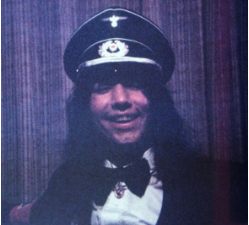
It is certainly troubling behaviour, and Paul Stanley has written about it in his autobiography. Yet Frehley, like Lemmy, defended his fascination as historical interest rather than ideological sympathy. He also pointed out that his girlfriend at the time, Rachael Gordon, was Jewish. This is where the waters become murky and where Rachel’s argument is at its most challenging.
There is an enormous amount in this book that surprised me. Some of it confirms stories that have circulated for years, while other revelations genuinely raised my eyebrows. Rachel’s achievement is considerable; he has produced a thoroughly researched, thought-provoking study that connects dozens of seemingly unrelated moments in popular culture. At times I think he reaches too far and sees connections that are simply not there, but that does not diminish the value of the discussion.
Ultimately, there is nothing wrong with being fascinated by history, even dark history. Enjoying Death in Berlin does not make me a Nazi, any more than having this book on my shelf does. What matters is understanding what these symbols represented and the suffering they caused. Rachel’s book serves as a reminder that while rebellion, shock and controversy may have their place in popular culture, some imagery carries a weight that should never be forgotten. No matter how rebellious you are trying to be, there should always be respect for those who suffered under that symbol.
There is a difference between:
- Being a Nazi (believing in Nazi ideology, racial supremacy, antisemitism, dictatorship, etc.).
- Using Nazi imagery for shock, artistic provocation, historical fascination, performance, rebellion or aesthetic reasons.
Many musicians crossed into the second category. Very few can be credibly placed in the first.
The challenge—and why Rachel’s book exists—is that the second category can still be deeply offensive because those symbols are inseparable from genocide, persecution and war. You don’t have to be a Nazi for people to question why you’re wearing the symbols of one.
Love what we do? Rock the Joint Magazine is completely free — no paywalls, no ads ruining the read — just passionate music journalism for 1,000+ readers a day. If you enjoy hanging out with us, please consider hitting the “Support Us” button and buying us a coffee on Ko-Fi. Even a small donation genuinely helps keep the magazine running, lets us publish more features, and reminds us that people value independent music writing.
By Anna-Louise Burgess
JOIN ROCK THE JOINT MAGAZINE ON A JOURNEY FOR THE BEST IN INDEPENDENT MUSIC JOURNALISM – WE COVER ROCK, COUNTRY, JAZZ AND CHRISTIAN MUSIC. LEADING FEATURES, INTERVIEWS, REVIEWS AND EDITORIALS. SUPPORT US ON KO-FI.