
All Photo Credits: Chad Cubberly
September 7, 2026
In the past, Thornetta Davis has opened for B.B. King, Ray Charles and Bonnie Raitt, and performed with Bob Seger, Kid Rock and two symphony orchestras. Chad Cubberly headed off to see her live in Detroit — read on for the review!
On a modest Royal Oak stage, Davis and her band showed how Detroit blues remains personal, communal and very much alive.
By the time Thornetta Davis was ready to play Monday evening at Arts, Beats & Eats, nearly every seat around the R&B/Jazz Stage was taken. The Joe Stanley Trio had finished, the sun was dropping over Royal Oak, and the mood around the stage was easy and conversational. People were settled in, talking and waiting. The stage itself looked almost undersized for the singer they had come to see.
Earlier, Davis had taken a few minutes to talk about the blues. Her answer was simple, but it carried the weight of someone who has spent years singing the music rather than explaining it.
“Blues will always stay relevant. If you’re living then you know the Blues. I feel very proud to be a Blues singer from Detroit.”
— Thornetta Davis
Davis also spoke with unmistakable pride about being Detroit’s Queen of the Blues. The city matters to her, as does the lineage behind that title. Detroit blues has long included figures such as Sippie Wallace, Alberta Adams, John Lee Hooker and Big Maceo, and Davis has spent much of her career insisting that the city’s place in the music be heard rather than treated as an afterthought.
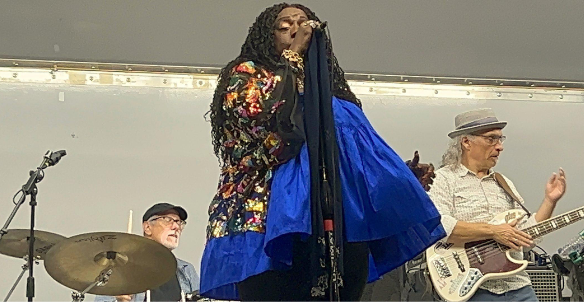
Thornetta Davis performs on the R&B/Jazz Stage at Arts, Beats & Eats, with drummer Dave Marcaccio and bassist Joe Veloz behind her. Royal Oak, Michigan.
A short time later, she stepped to the microphone with Carlton Washington on guitar, Phillip Hale on keyboards, Joe Veloz on bass, James Anderson on percussion and Dave Marcaccio on drums. Washington has been part of Davis’s musical world for years, and the familiarity between singer and band was evident almost immediately.
Davis took centre stage in bright blue beneath a sequined jacket, but the clothes were not what held the eye for long. She worked the small space naturally, pointing into the crowd, talking to people and pulling responses back towards the stage. The audience had been mellow before the set. Once Davis settled in, the set became a conversation.
That exchange became the character of the performance. Davis did not simply deliver a polished festival set and move on. A line went out from the stage and came back from the seats. A love song became a singalong. A quieter passage pulled the crowd closer. Even when the band was cooking, she remained aware of the people only a few feet in front of her.
Her voice carried plenty of weight, but the set moved too freely to stay inside one box. Soul, funk, rock and gospel feeling all surfaced without needing to be announced. The common thread was Davis herself: direct, physical, funny when she wanted to be, and comfortable letting a song change the temperature of the crowd.
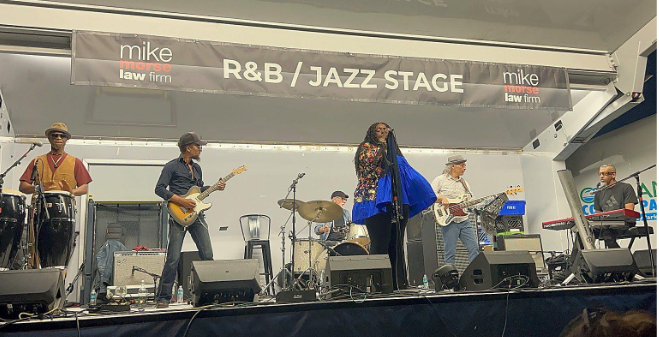
The Thornetta Davis Band on the R&B/Jazz Stage. From left: James Anderson, percussion/vocals; Carlton Washington, guitar/vocals; Dave Marcaccio, drums; Thornetta Davis; Joe Veloz, bass; and Phillip Hale, keyboards/vocals.
The clearest shift came with “I Am America.” Up to that point, people had been talking, responding and singing along. Then the noise around the stage fell away. Davis did not ask for attention. The song got it. A crowd that had been loose and conversational became still enough to listen.
It was the showstopper, not because it was the loudest moment, but because it changed the behaviour of the crowd. At a street festival full of competing stages, food lines and people moving in every direction, silence can be a pretty good measure of attention.
Then Davis gave the band room to speak.
When they tore into “Whipping Post,” the neat lines separating blues, soul, rock and funk stopped mattering. Washington stepped forward on guitar; Hale took his turn on keyboards; Veloz, Anderson and Marcaccio each got room to push the music in a different direction. Washington in particular was fierce, but the point was larger than any single solo.
The solos did not feel like decorations added to a singer’s set. They felt like part of the conversation. Davis watched the players, encouraged them and knew when to step aside. She could own the center of the stage without needing to occupy it every second.

Guitarist Carlton Washington stretches out during the set.
That may have been the most revealing thing about Davis as a bandleader. The musicians were not scenery behind the Queen of the Blues. They were trusted participants in the set, and she made sure the crowd heard them that way.
The stage never got any bigger. It simply stopped mattering.
Before the show, Davis had said, “If you’re living then you know the Blues.” By the end of the set, it was difficult to improve on her definition. The music had been used to flirt, testify, laugh, stretch out, quiet a crowd and pull people together. Nothing about it felt preserved behind glass.
It felt lived in.
And by the time Thornetta Davis walked off that small Royal Oak stage, “Detroit’s Queen of the Blues” sounded less like a nickname than a job she was still very much doing.
Thornetta Davis at Arts, Beats & Eats Detroit.
Love what we do? Rock the Joint Magazine is completely free — no paywalls, no ads ruining the vibe — just passionate music journalism for 1,000+ readers a day. If you enjoy hanging out with us, please consider hitting the “Support Us” button and buying us a coffee on Ko-Fi. Even a small donation genuinely helps keep the magazine running, lets us publish more features, and reminds us that people value independent music writing.
Artist Website here
Stream Music from Thornetta Davis here
Words and photography: Chad Cubberly

Chad Cubberly is a writer and music journalist based in Michigan whose work focuses on the people, history, and lived culture behind American roots and blues music. He is also a licensed master social worker and Marine veteran.
Join Rock the Joint Magazine on the road to the best independent music journalism, interviews and reviews. We cover Rock, Country, Jazz, Blues and Christian music. Support us on Ko-Fi (link on each page) to help the magazine grow and value independent journalism.