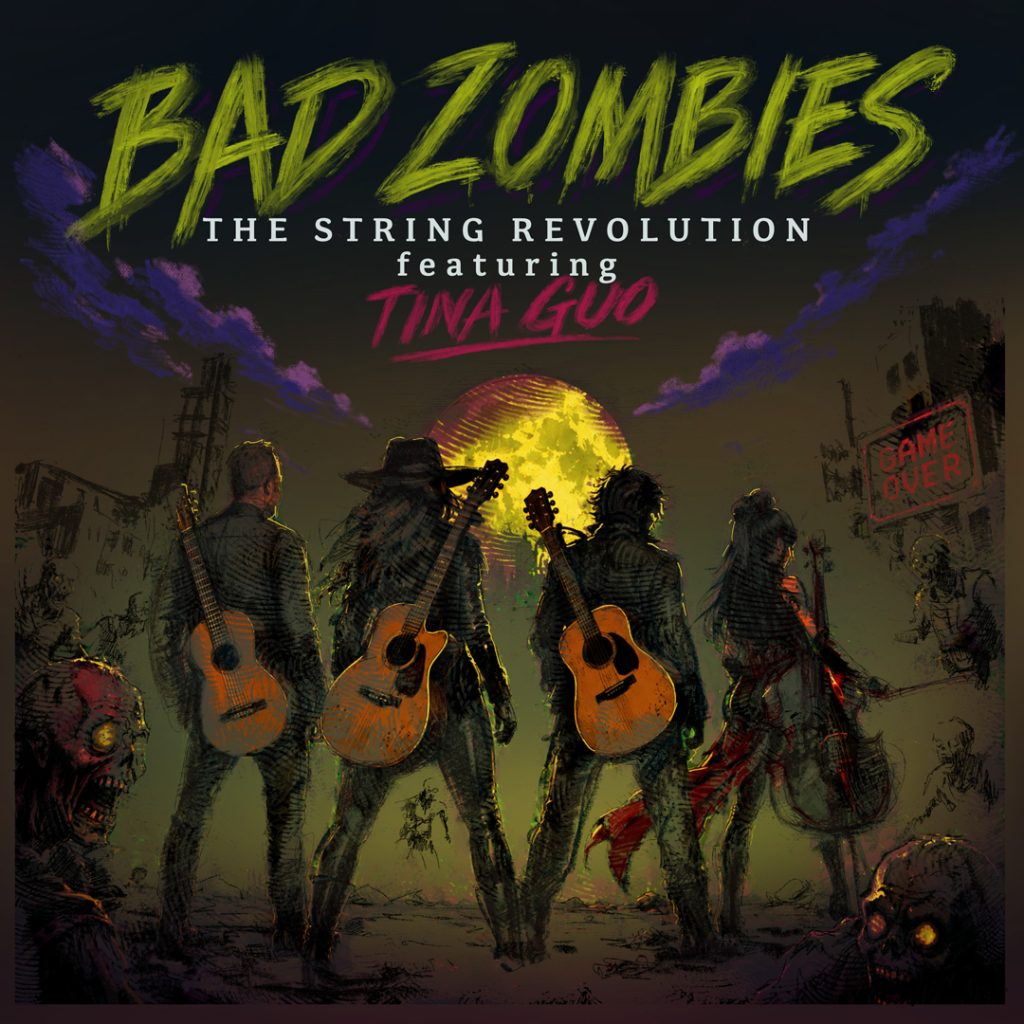
We recently finished a review of the new single from The String Revolution (here) – it was entirely spooky and enjoyable, called “Bad Zombies” and based around that classic game Plants vs. Zombies, where you control your plant army to maim, electrocute, blow up and destroy the invading zombies! I love the game and couldn’t resist the single! But there is so much more to The String Revolution than destroying those zombies! I was very pleased to get to interview guitarist Janet Robin, who discusses The String Revolution and a life in music, among other things (!) with us here.
Here is the press release –
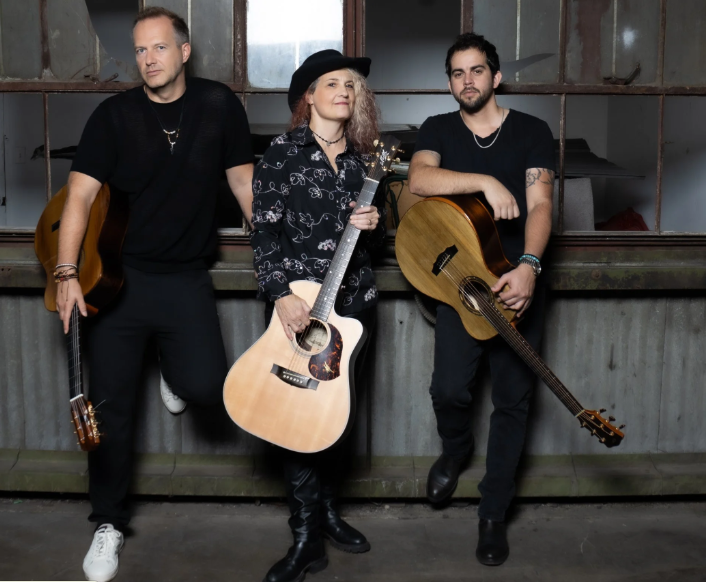
GRAMMY® Award-winning guitar trio The String Revolution is celebrated for pushing the boundaries of guitar music through dynamic performances, genre-blending arrangements, and exceptional musicianship. The ensemble features Janet Robin, a former student of Randy Rhoads and touring guitarist for Lindsey Buckingham, Meredith Brooks, and Air Supply – alongside award-winning Austrian guitarist and composer Markus Illko and acclaimed multi-instrumentalist Cuban guitarist Rober Luis.
Together, the trio creates a distinctive sound that combines classical, rock, jazz, cinematic, and world-music influences. Through intricate melodies, rich harmonies, and virtuosic playing, The String Revolution has developed a global following and earned more than five million streams across its catalog.
The group first gained attention with its debut album, “Stringborn,” in 2016, followed by “Red Drops” in 2019. The latter featured the trio’s inventive interpretation of Michael Jackson’s “Billie Jean,” which reached Spotify’s Los Angeles Instrumental Top 10. The String Revolution has since become known for reimagining iconic songs such as “Rocket Man” and “Englishman in New York,” transforming familiar music into original instrumental experiences.
In 2024, the trio won the GRAMMY® Award for Best Arrangement, Instrumental or A Cappella for its powerful reimagining of Johnny Cash’s “Folsom Prison Blues,” featuring legendary guitarist Tommy Emmanuel.
My Interview:
I’ll start with the new single, “Bad Zombies” — I love playing Plants vs. Zombies on my phone, blowing the zombies up and placing a battery of plants in their lines! Did you play the game before the song, and how did that rather unusual idea come about?
Janet: I actually never played Plants vs. Zombies before! Of course, when I found out we were going to do a mashup of the theme song and “Bad Guy,” I quickly downloaded the game and became fully addicted.
The story goes as such… Steve Schnur, who is the worldwide EA Games Music president, approached us about doing this idea of a mashup. Of course, EA Games distributes Plants vs. Zombies, and they were getting ready to release an anniversary version.
Being the band that we are, we are known for doing covers of iconic classics and uniquely arranging them. He met with us and mentioned trying out an arrangement of “Crazy Dave’s Theme” from Plants vs. Zombies by Laura Shigihara and Billie Eilish’s “Bad Guy.”
We had no idea of the connection. Because there is an actual connection. Apparently Billie and Finneas, her brother, used to play this game all the time when they were kids and, in the course of writing “Bad Guy,” they were subconsciously inspired by the theme song to that game. You can kind of hear the connection. Even though it’s not the same melody, it’s got the same vibe.
Apparently Steve Schnur approached Billie and Finneas about this idea and they were totally into it as well, so we all got together — a massive team of arrangers, nine people, in fact — and went through various demo versions while we were arranging it.
Finally, we came to a final version we were all happy with.
At the magazine, we are lovers of music first and foremost. I’m not particularly musical myself, but I listen to a lot of music! When I review, I tend to lean into how a song makes me feel and where it takes me, and then link that to emotion. Is that something you appreciate in a review, or do you think music criticism should be more technical? With “Bad Zombies”, for example, we described it (my colleague Stevie did that review) as “an Old West saloon, a lonely street, a creepy old house inhabited by a forest witch” — and that genuinely is where the music took us.
Janet: Yes, I saw that. I thought that was super cool! For me, it is more important the emotion that a listener feels when listening to music. Yes, of course, the sound quality, technical progress, etc. are important, and that all contributes to the overall feeling.
But in the end, it is where the song takes you in your emotion and feeling. Everybody’s gonna have a different take on a song and I feel like it should be like that. Songs are personal and intimate, and the feeling can be different for every listener to me.
That’s what’s exceptional about any kind of creative art.
How did Tina Guo become involved in “Bad Zombies”, and what does a cellist with her background bring to a guitar trio’s arrangement?
Janet: So that’s another interesting story. We were all aware of Tina Guo. In fact, Markus Illko, our bandmate, did some work with her or met her before we had her on this recording.
Steve Schnur thought it would be a great collaboration to have her as a featured artist to bring cello into our arrangement. We, of course, jumped on that, because she is a badass and her background and playing with Hans Zimmer and all these soundtracks was fitting for a song like this.
Even though it’s a single, it does have a little bit of a soundtrack feel.
She completely nailed it and we couldn’t be more honored to have had her on this track.
It was a long time ago that we lost Randy Rhoads and, of course, Ozzy more recently. Randy’s guitar work on those first two Ozzy solo albums was extraordinary. I read that you took guitar lessons from him before Ozzy — can I ask what he was like, and do you have a particular memory of him that you could share with us?
Janet: Yes, I took lessons from Randy while growing up here in North Hollywood, California. He taught at his mother’s music studio, which happened to be five minutes from my house where I grew up. I studied with him from about age 9 until 15, when he got the gig with Ozzy. I have so many stories about him and he is really the ultimate reason I am still playing guitar.
What I can say is that he was the most humble, quiet, gentle soul I have ever met in the rock ‘n’ roll industry. He was non-judgmental about the fact that I was a girl playing guitar, and I was his youngest student as well. All he cared about was that I was passionate, inspired and practiced, and that’s exactly what I was. But that’s because he was the same and he was so amazing and unique.
I just savor every lesson with him and every word that came out of his mouth.
In regards to music and playing guitar, even at a young age, what I can say is that as a girl playing rock guitar during that time, it was not very common. But because he believed in me and was gender-blind, age-blind, it provided me with so much self-esteem that there’s no way I would’ve continued to play guitar or, in fact, make it a career without that initial support.
I miss him so much and am happy to say I’m still in touch with his family. I hope he’s up there smiling and proud of my accomplishments because all of them are because of him.
Your Wikipedia page describes The String Revolution as a “side project”. For a side project, it has been remarkably successful — a GRAMMY, millions of streams and an international audience. Has the project become much bigger than you originally envisaged?
Janet: Yes, I noticed that recently. It did initially start that way, but that’s because I was actively touring and still recording some of my solo work. I ended up having a lot of difficulties with my voice and had surgery on my vocal cords. It took a long time to recover, and became more difficult to sing.
I was really not ever a singer per se. I think I had a cool tone and I’m a good songwriter, but my main jam is really playing guitar. I pivoted more into The String Revolution when I started having trouble with my voice; more interesting things were happening with The String Revolution. That inspired me, so it just became natural for me to lean into the band, which is my primary focus right now.
I have been doing a lot of production lately on other singer-songwriters’ records as well as composing and working on various reels for game, audio, soundtrack songs. I think at this stage of my career, I can have a multifaceted career of music and I’m excited about all the opportunities that can come with that.
I’d also like to mention your lovely version of “An Englishman in New York”. The original was beautifully eccentric, which seems entirely appropriate given Quentin Crisp, whom Sting knew. I think you retained that eccentricity but gave it a plucky, fresh, jaunty quality. What are your own reflections on that arrangement?
Janet: I don’t believe we actually knew anything about Quentin Crisp’s involvement in this song as far as Sting dedicating it to him. I had to look that up! As a band, we simply pick songs when we want to do a cover that speak to us. Sting is a gorgeous songwriter. His melodies are fantastic and that particular song lends itself to a very sustainable guitar melody. It’s very recognizable.
The approach to the arrangement was to keep the soul of the original but put our own String Revolution stamp on it. Because it’s all guitar mostly, you have to be careful when rearranging iconic hits like this. You need to make it sound a little bit different because we are not simply copying the original version.
I think the reggae groove that we have keeps it poppy and dancing. Then Markus and I are playing intertwining melodies throughout the song, including harmonies on important melodic lines like the title of the song. I think when we hit the bridge section, we got a little bit concerned because it kind of goes into alternate timing and breakdown. Jazzy kind of thing, so we had to come up with something more unique and percussive, which is exactly what we did.
I’m very proud of how that bridge turned out in our version of “Englishman.”
It is a hard winter’s night. The tour van has broken down and a harsh wind blows through the darkness. Nearby you discover what appears to be an abandoned house. There is a roaring fire, a table laid with hot food, electricity still works… and somehow nobody is there.
Janet: Well, I like to call that divine intervention…
There have been so many times when things have happened on the road and you feel like you might be lost or stuck somewhere and somehow, out of the blue, there is a rescue in some shape. I feel like when you are following your true path in life, no matter the risks and dangers that come along with it, if you are true to yourself and genuine in your work and how you feel about it, positive actions can come out of negative situations. 🙂
Last question — You can invite one artist — past or present — into the rehearsal room for a day. Who would it be, and why? (I would have Elvis or B.B. King — but it’s an open door!)
Janet: That is a really tough question because there are so many artists. I would love to have met Janis Joplin, Jimi Hendrix, Jim Morrison. All those people, but one comes to mind in regards to the history of rock ‘n’ roll and the history the guitar played in rock ‘n’ roll, so I think it would be rather cool to meet and perhaps sit down and jam with celebrated father of blues guitar Robert Johnson.
However, I feel like just calling him a blues guitarist is not fair because honestly all rock ‘n’ roll comes from the blues, so any of those guys and gals who were playing that music back in the early 1900s started this American revolution of music called rock ‘n’ roll entirely… invented by black Americans, it is an American invention…
Our cultural music, heritage rock ‘n’ roll, was not born anywhere else in any other country, it was born here, so I would certainly love to go to one of the sources and jam out and talk about it all with one of those guys/gals who were doing it back when it all started.
The Music
I can’t end without a listen to at least a couple of tracks! I will avoid the new single as we have reviewed it recently; however, I can dip into a couple of covers that I would say are absolutely worth your attention.
“Crazy Train” (a tribute to Randy Rhoads) – this is so identifiable, yet the guys at The String Revolution give it a make-over. The single features the work of Steve Stevens (Billy Idol) – it is a slick acoustic/Spanish-style version that took me toward those hot nights in Madrid (I had a few!) where the guitar players are in these little flamenco bars. The guitar work here is simply sublime, you absolutely have to admire it, and that riff is still there to rock along to.
“Rocket Man” takes the Elton John classic and breathes a new dimension into it for the listener. Stripped of the lyrics, you drift into this rocket ride smoothly! I view a cover as needing to do more than reproduce; I like a cover to add something new, and throughout their work The String Revolution do exactly that. I’d love to come across them live, I’d bet that is a real treat!
Love what we do? Rock the Joint Magazine is completely free — no paywalls, no ads ruining the read — just passionate music journalism for 1,000+ readers a day. If you enjoy hanging out with us, please consider hitting the “Support Us” button and buying us a coffee on Ko-Fi. Even a small donation genuinely helps keep the magazine running, lets us publish more features, and reminds us that people value independent music writing. Remember, I work hard for you here!
You can stream music by The String Revolution here
By Lorraine Foley

JOIN ROCK THE JOINT MAGAZINE ON A JOURNEY FOR THE BEST IN INDEPENDENT MUSIC JOURNALISM – WE COVER ROCK, COUNTRY, JAZZ AND CHRISTIAN MUSIC. LEADING FEATURES, INTERVIEWS, REVIEWS AND EDITORIALS. SUPPORT US ON KO-FI.