“Remember—in all things, as Nietzsche said—there is no truth, only interpretation. Any story depends very much upon who is doing the telling.”
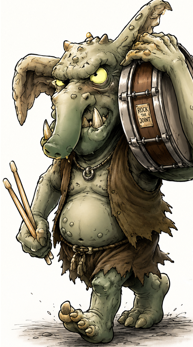
It was a long time ago, in the far north of the world, when Ferdinand first made his way down a mountainside.
He was leaving his cave.
To explain, his mother had abandoned him as soon as she possibly could. Trolls have always struggled with attachment, even toward their own kind, and she was no exception. Solitary by nature, she disappeared the moment he was old enough to survive alone.
The cave became Ferdinand’s entire world.
He lived on rabbits caught on the mountainside, together with a carefully cultivated patch of carrots and pak choi, which he tended with surprising skill. Occasionally he would lumber towards the little human village at the foot of the mountain. Sneak would be the wrong word, however, as a young mountain troll of average intelligence is entirely incapable of sneaking.
From the shadows he would listen to the songs drifting from the village inn, and it was there that he discovered rhythm.
Back in his cave, he fashioned himself a crude snare drum from branches, stretched hide and twine. Night after night the mountain echoed with enthusiastic, if not always accurate, drumming.
His mother had never given him a name, but one evening he heard a woman calling a young boy named Ferdinand through the village streets. He rather liked the sound of it, and so decided it should be his own.
For a while, life was content.
Then everything changed.
One autumn afternoon, a group of village girls searching for truffles beneath the old hazel trees heard the distant sound of drumming.
Curiosity overcame caution.
Peering into the cave, they caught sight of Ferdinand.
That was quite enough.
They fled downhill screaming in absolute terror, trampling straight through his carefully tended bed of pak choi without the slightest concern.
By the time they reached the village, the tale had grown considerably. There were stories of monstrous trolls, unspeakable wickedness and terrible danger.
Before long the village men gathered with hunting dogs.
Ferdinand understood.
With a heavy heart he left by the rear of the mountain and disappeared into the great forest, where the trees were so ancient that daylight rarely reached the forest floor.
For a week he wandered deeper into the woodland until every trace of civilisation had vanished.
Then he found it.
A broad river full of fish. A grassy meadow on one bank. Sheltering woodland on the other.
It seemed perfect.
Being a practical troll, Ferdinand set about building himself a bridge.
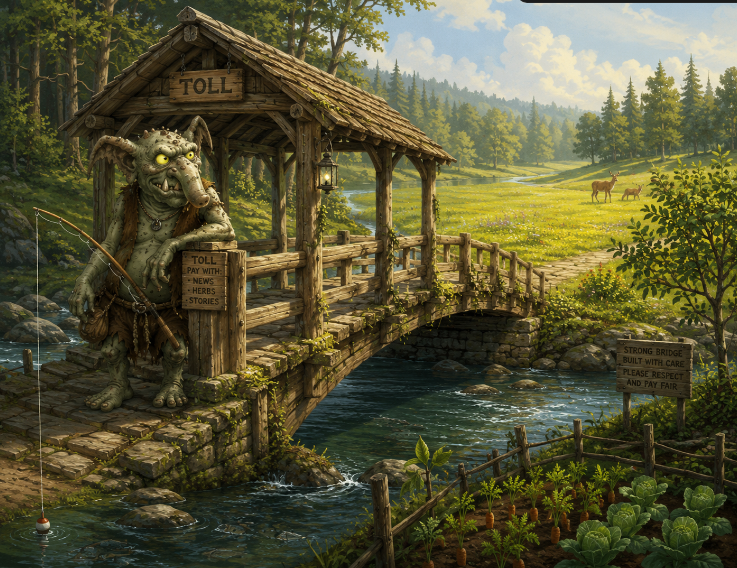
It was a remarkably sturdy affair, fashioned from great timbers strengthened with stone. Wide enough for carts, it even had a roof to shield him from bright sunlight while he fished beneath it.
Nearby he replanted his carrots and pak choi.
He even discovered a small bay tree, which he carefully transplanted beside the bridge. The leaves made an excellent addition to his cooking, and he would hang them from the beams to dry.
Being a troll of tradition, Ferdinand also established a modest toll.
Nothing unreasonable.
Travellers could simply exchange a little news from the outside world, a handful of useful herbs, or perhaps an interesting story.
Hardly anyone came.
Save for one forest witch.
She crossed the bridge regularly, always complimented Ferdinand on his workmanship, faithfully paid her toll in gossip and herbs, and gradually taught him a little healing magic besides.
Life settled into a pleasant routine.
He fished.
He gardened.
He repaired his bridge.
He played the drums.
It was peaceful.
Then, one October afternoon…
Trip. Trap. Trip. Trap.
The bridge shook.
Not merely from footsteps, but from enthusiastic jumping.
Ferdinand had been fishing, and every fish within twenty yards disappeared downstream.
“Who’s tripping over my bridge?” roared Ferdinand.
“Oh, it’s only I,” squeaked the smallest Billy Goat Gruff. “I’m going to the meadow to eat the lovely grass and grow fat.”
“You’ll need to pay the toll,” said Ferdinand. “It isn’t much. Some news from the world would do nicely. Or perhaps a few herbs for my cooking pot. Otherwise… tradition rather suggests I ought to eat you.”
“Oh dear,” replied the little goat. “I’m far too small to know anything of the world. Wait for my brother. He’s much bigger and will surely pay double.”
That sounded reasonable.
So Ferdinand allowed him to pass.
Sadly, the little goat wandered straight through Ferdinand’s neat rows of carrots without giving them a second glance.
Ferdinand sighed.
An hour later…
Trip. Trap. Trip. Trap. Trip. Trap.
Again the fish fled.
Again Ferdinand climbed from beneath the bridge.
“Who’s tripping over my bridge?”
“It’s me,” replied the second Billy Goat Gruff. “I’m going to the meadow to eat the juicy grass and grow fat.”
“The toll is now double,” said Ferdinand. “Your younger brother paid nothing whatsoever and has walked all over my carrots.”
“I’m afraid I have nothing,” said the second goat. “But wait for my elder brother. He’s older, wiser and knows all about the world.”
Once again Ferdinand relented.
The second goat thanked him by marching directly through the carefully planted pak choi.
Ferdinand sighed even more deeply.
Then came the largest Billy Goat Gruff.
TRIP. TRAP. TRIP. TRAP. TRIP. TRAP!
The bridge groaned beneath his weight.
Several stones tumbled into the river below.
“Who’s trampling over my bridge?” bellowed Ferdinand.
“It is I,” replied the great Billy Goat Gruff in a deep, unpleasant voice.
“The toll is now triple,” said Ferdinand patiently. “Neither of your brothers has paid. They have destroyed my carrots, ruined my pak choi and now you’ve damaged my bridge. Tell me some news. Bring me herbs. Anything at all.”
The great goat said nothing.
He lowered his head.
Then he charged.
His horns struck Ferdinand squarely in the chest, hurling him into the river below.
The current swept the troll helplessly downstream.
As he disappeared, Ferdinand looked back.
The great goat casually bit through his beloved bay tree before leading the others into the meadow, where they churned the grass into mud beneath their hooves.
Ferdinand felt very sad indeed.
Bruised, exhausted and dripping wet, Ferdinand eventually dragged himself onto the riverbank.
There stood a little cottage.
Outside it was the forest witch called Tegan.
She took him inside without asking questions.
She tended his wounds with herbs and quiet magic, then built him a comfortable home beneath the great oak beside her cottage.
There Ferdinand remained.
She sang.
He played the drums.
Sometimes they shared fish cooked with bay leaves borrowed from a newly planted tree.
And all was well.
The three Billy Goats Gruff grew very fat indeed.
In time they ruined the lovely meadow they had fought so fiercely to reach.
Yet somehow it was Ferdinand who became the villain of the story.
Funny, that.
For just because something is repeated often enough does not necessarily make it true.
By Mark C. Chambers

JOIN ROCK THE JOINT MAGAZINE ON A JOURNEY FOR THE BEST IN INDEPENDENT MUSIC JOURNALISM – WE COVER ROCK, COUNTRY, JAZZ AND CHRISTIAN MUSIC. LEADING FEATURES, INTERVIEWS, REVIEWS AND EDITORIALS. SUPPORT US ON KO-FI.