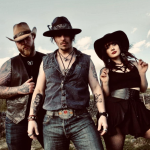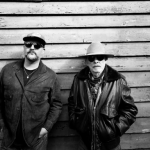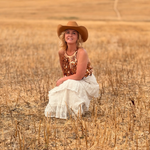
I do believe our readers will have a lot to enjoy here. This is a more off-center kind of interview and review, as Rocket Horse is a very genre-fluid project. I had intended to spend the day outdoor decorating, but the wind had other ideas, so I settled down with my trusty companion Sir Meows a Lot to write up a recent interview I had with Brian Myk of Rocket Horse.
Rocket Horse has been around for some time and has a substantial catalogue of songs, along with a growing listener base and online presence. Essentially, it is an independent songwriting and streaming music project that recorded more than 260,000 plays across digital platforms in early 2026. We decided to say hello!
Press Release/Bio:
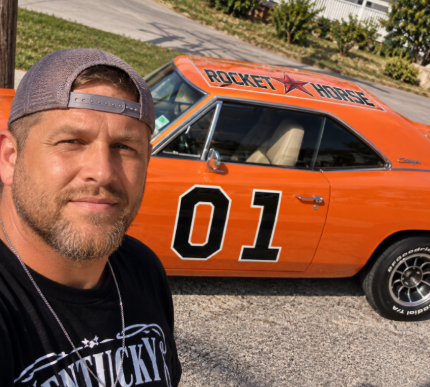
Rocket Horse is an independent songwriter-led studio project from Jasper, Georgia, created by BMI songwriter Brian Myk. The catalogue spans rock, country-rock, Americana, alternative, pop-rock, and ballads, with roughly 170 released or release-ready songs. Rocket Horse has built a social media following of more than 100,000 and crossed one million streams across platforms over the last year. The project began with traditional musician-recorded releases, including “Revolution,” which appeared in the film How to Cook a Frog, and has since expanded into a modern studio workflow that also uses AI-assisted production on some newer material.
The Interview:
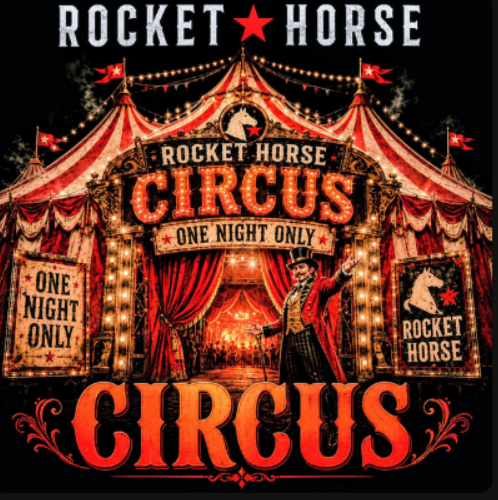
The first track of yours I listened to was “Circus”—the new single, I think, as it was released on August 26. I liked it a lot—clearly country, but with this funk feel and a chorus strutting its way through my headphones. Would you say it is a good entry point for me into your music? Tell me a bit about it from your perspective.
Brian: I think it actually is a pretty good entry point into Rocket Horse. “Circus” is basically about everybody coming together to have a good time, whatever their version of a good time happens to be. The important part is they’re doing it together. There’s this one place nobody really knows who started it, it keeps growing, and eventually it becomes this big cool thing where everybody’s invited. In a weird way, it’s probably a metaphor for Rocket Horse. We’ve got rock, country, pop, a little R&B, a little gospel and, fortunately or unfortunately, a little fire mixed in there too. Sometimes all those things land in the same song. So yeah, “Circus” probably makes a lot of sense as a place to start.
I see you are quite open about using AI as part of the writing and production process now. There is no need for us to be shy about it either—we use AI to proofread, edit, and check what we write, as well as for some artwork (although not all of it; some is human-created). In the arts, though, AI is a controversial subject. What is your position on the role of AI in modern music?
Brian: Whether people like it or not, AI is here, and I think it’s here to stay. Music reflects society and the world around it, and as the world and technology change, music changes too. You can hear that all through the history of recorded music. I understand both sides of the argument. Some people say AI music isn’t real music, and some people worry that it’s going to take work away from musicians. I probably sympathize more with the second concern than the first. But I also think musicians are going to start using these tools themselves—and probably already are—while still keeping real instrumentation and musicianship involved.
Part of it is just keeping up with the Joneses. I look at it a little like movies. When you go see dinosaurs on a screen, they’re obviously not real dinosaurs. When you see superheroes flying, those people aren’t really flying. Technology is helping somebody create something that otherwise couldn’t exist in quite that form. In a strange way, I think some of what’s happening with AI and music is another version of that. The big question is still what the human being brings to it.
Rocket Horse had a substantial traditional catalogue before we ever experimented with AI-assisted production. “Revolution,” for example, was recorded traditionally and ended up being featured in the film How to Cook a Frog, a 2010 comedy documentary. Once we started experimenting with some of these newer production tools, though, the response was pretty interesting. The streaming and attention around the project really started moving. My heart is still with traditional songwriting and musicianship. I just also recognize that this is part of music now. I don’t think you have to abandon one to understand or use the other. At some point you probably either get at least partially on the train or you risk watching it go by.
Turning to “Good Girls Party”—here in the UK, country music is many-headed. A lot of artists—Fangslinger, for instance—are taking country and blending rock or pop into the mix. This duet plays with eighties hair metal, pop and Americana—a stylish nod to hot tubs and bikinis, lol. Do you see music genres as more fluid now than they ever used to be?
Brian: I do think they are, and I’m a big fan of that. I’ve always liked a lot of different kinds of music, so naturally those influences come through when I write. Sometimes I’ll lean more toward country, sometimes rock, sometimes pop or something else, but there’s usually something from those other influences hiding in there too.
One thing I like is that you can hear two Rocket Horse songs performed by totally different vocalists or in completely different styles and hopefully still think, “I can hear that the same guy wrote those.” I also think crossing genres gives you a chance to reach more people. I write music because I want people to enjoy it and feel something from it. If you can reach people from several different musical worlds with one song, to me that’s kind of magic.
One of the disadvantages of being more of a musical chameleon is that people can be a little unsure what to expect—Miley Cyrus is someone I would nod toward in this regard; she moves between musical styles wonderfully, but there are dangers inherent in doing so. Do you keep a core audience in mind? I played quite a few of your tracks; “Green-Eyed Eyes” brought me towards dance, and “No Pyjamas” had that funky feel that I like—so “No Pajamas” and “Circus” were favourites—but I found getting a solid feel for your sound was tricky. Not a bad thing…but noted!
Brian: I do have a core audience in mind. If I had to put the center of Rocket Horse somewhere, it would probably be country, country-rock, and country-pop. My own background as a listener started much more with rock, oldies, Motown, and R&B, so I’ve always been into different sounds. I think that’s part of why modern country appealed to me as a writer.
Modern country can have rock in it, pop in it, big melodies, guitars, storytelling—all kinds of stuff. It gives you a lot of room. At the end of the day, I like writing music that feels good. It can rock, it can be emotional, it can be funny, it can be serious, but I like melody, and I like songs people want to hear again. So even when Rocket Horse wanders into different places, that country/country-rock/country-pop center is usually still somewhere in there.
You operate outside a traditional live-band model—yet I see your music as quite visual and cinematic. Do you ever pick up an acoustic guitar and sing a couple of songs to friends, or would you adapt songs as animations? I say this because the visuals on YouTube for “Monster Kid” were very good—and I thought, “Get some animations in here along with that harmonica!”
Brian: Yeah, I think so. We’re living in a very visual society now, and I think that side of music is only becoming more important. You can already see that in a lot of the artwork around Rocket Horse, and like you mentioned with “Monster Kid,” sometimes the sound of the song itself almost asks for something visual to go with it.
My whole songwriting philosophy is hooks and melodies. I don’t really believe you can have too many hooks in a song. Even with a ballad, I still think that way. “Shotgun Wedding,” for example, is a power ballad that’s been doing really well for us, but it’s still loaded with hooks. That song almost begs for a proper video.
And yeah, at some point I’ll probably get out there and sing a few sets too. I haven’t really built Rocket Horse around the traditional live-band model, but I can definitely see that becoming part of it as things keep growing. So as Rocket Horse keeps progressing, I absolutely see more video, animation, visual storytelling, and some live performing becoming part of it.
A bit of homework told me you are a KISS fan—now they are a visual band with quite a history (I’ve seen them live and met them). They are unveiling these holograms next year, I believe, so virtual, AI-style tour residencies—ABBA has one in London. Do you admire this kind of idea, or do you believe “live” should mean live humans out there?
Brian: That’s a great question. I think if you’re calling something a live show and you’re promoting the actual band, then ideally live should still mean the band members are really there playing. That’s still what I personally prefer. I like musicians onstage actually doing it.
That said, I think what KISS is doing is really smart, and I think we’re going to see a lot more of it. Their fans are going to want that experience. It gives the music and the brand another life, it creates another revenue stream, and once somebody proves that it works, other artists are going to follow. Again, people keep up with the Joneses.
It’ll never touch the real thing for me. Seeing the actual musicians onstage is different. But I do think virtual shows, holograms, and that whole kind of experience will eventually become pretty normal.
Are your musical aspirations the same now as they were when you set out to be a performer? How are you setting goals for releases at this stage?
Brian: I’d say they basically are. From the beginning I wanted to write really good, compelling music. I wanted to write things that I enjoyed listening to myself, because I think every artist probably starts there, and then you hope other people connect with it too.
I’ve been fortunate that people have, and now Rocket Horse is picking up some really interesting momentum, even internationally. For somebody who started out essentially as a songwriter operating out of a small town in North Georgia, that’s really cool to see. And having people like you give independent artists a place to talk about what they’re doing makes a difference too.
So the goal is still pretty simple: keep writing songs I believe in, keep putting them out, and keep getting them in front of more people. The scale of it is just starting to become a lot bigger than it was when I began.
It’s a freezing winter’s night in Alaska, and the tour bus has broken down miles from anywhere. Luckily, you stumble across what appears to be an abandoned house. There’s a roaring fire, a table full of food, and the electricity still works. While you wait for morning, you can choose only one book and one film to keep you company. What are you picking?
Brian: The book would be the Bible. That may sound cliché, but honestly, if I’m stuck overnight somewhere in Alaska, that’s probably exactly what I’d want. Alaska is probably a pretty incredible place to be stuck for a night anyway, but some inspiration, some perspective, and maybe a little praying material in case we never get out of there would probably come in handy.
For the movie, it would probably come down to 300, Gladiator, or The Big Lebowski. But if I’m stuck in Alaska for the night, I’d probably keep things a little lighter, cooler, and more fun and go with Lebowski.

The Music:
There is a lot of music under the Rocket Horse umbrella. For this piece, I have chosen a few that I enjoyed and am happy to put forward for you to have a listen to.
“Circus” is the new single and the track I heard first. I liked the slower, funky rock groove it settles into—“Girls in the attic, boys out back…” It has a great, fun attitude, where the whole damn party is a circus. I quickly got into the groove and enjoyed the feel of the music. There is a real danceable quality to the whole track, and it breaks into this “dum dum” kind of thing in the middle—you need to have a listen! A good track, very good!
“Rockstar” is a natural listening companion to “Circus,” as it has a rock feeling throughout—think eighties hair metal with a modern feel and a sense of humor. It comes with a big drum sound and an eighties-style vocal: “lipstick on the dashboard.” Again, it is one of those enjoyable driving songs; no need to think too hard, just find an open road and turn it up.
“Selling Sun” is straight down the driving lane too. The aim of this music is to sell a smile and company, where the sun shines and the drink is on tap! It has that bar feeling; I’m sure you would enjoy this song best with a pool cue and a few friends. It would be an easy choice for the jukebox about the time I cleaned out the table.
“I’m Your Best Best” finishes my little run-through, and with so many tracks to choose from, this little selection is a lot of fun. This is a little tribute to your bestie! A bit of rock with some country blended in. It’s uncomplicated, holds a neat beat, and sounded great while I was doing the cooking! My four-legged companion was less keen on this one, but his view was tempered by his not being fed for at least an hour.
So, what exactly is Rocket Horse? Well, I’m still not entirely sure—and I rather like that.
There is a definite country and country-rock heart here, but Brian Myk clearly has little interest in staying inside one musical fence. Rock, pop, Americana, funk, R&B, and more all wander through the catalogue, sometimes separately and sometimes seemingly having a party together. That makes Rocket Horse an unusual proposition, but it also makes exploring the music rather fun.
The AI question will inevitably divide opinion, and it is something the project is refreshingly open about. Whatever your own view, there is a substantial catalogue here, plenty of ideas, and a songwriter who clearly enjoys experimenting with where a song might go next.
I came away with a handful of favorites and decided to hear “Circus” again, with the feeling that I probably haven’t heard enough of Rocket Horse yet. And perhaps that is the best result an interview like this can produce.
Now, if you’ll excuse me, Sir Meows a Lot and I have a date with the jukebox.
*
Love what we do? Rock the Joint Magazine is completely free—no paywalls, no ads ruining the vibe—just passionate music journalism for 1,000+ readers a day. If you enjoy hanging out with us, please consider hitting the “Support Us” button and buying us a coffee on Ko-Fi. Even a small donation genuinely helps keep the magazine running, lets us publish more features, and reminds us that people value independent music writing—it’s nice for us to feel appreciated too!
Stream music from Rocket Horse here
By Anna-Louise Burgess
Join Rock the Joint Magazine on the road to the best independent music journalism, interviews, and reviews. We cover Rock, Country, Jazz, Blues and Christian music. Support us on Ko-Fi (link on each page) to help the magazine grow and value independent journalism.