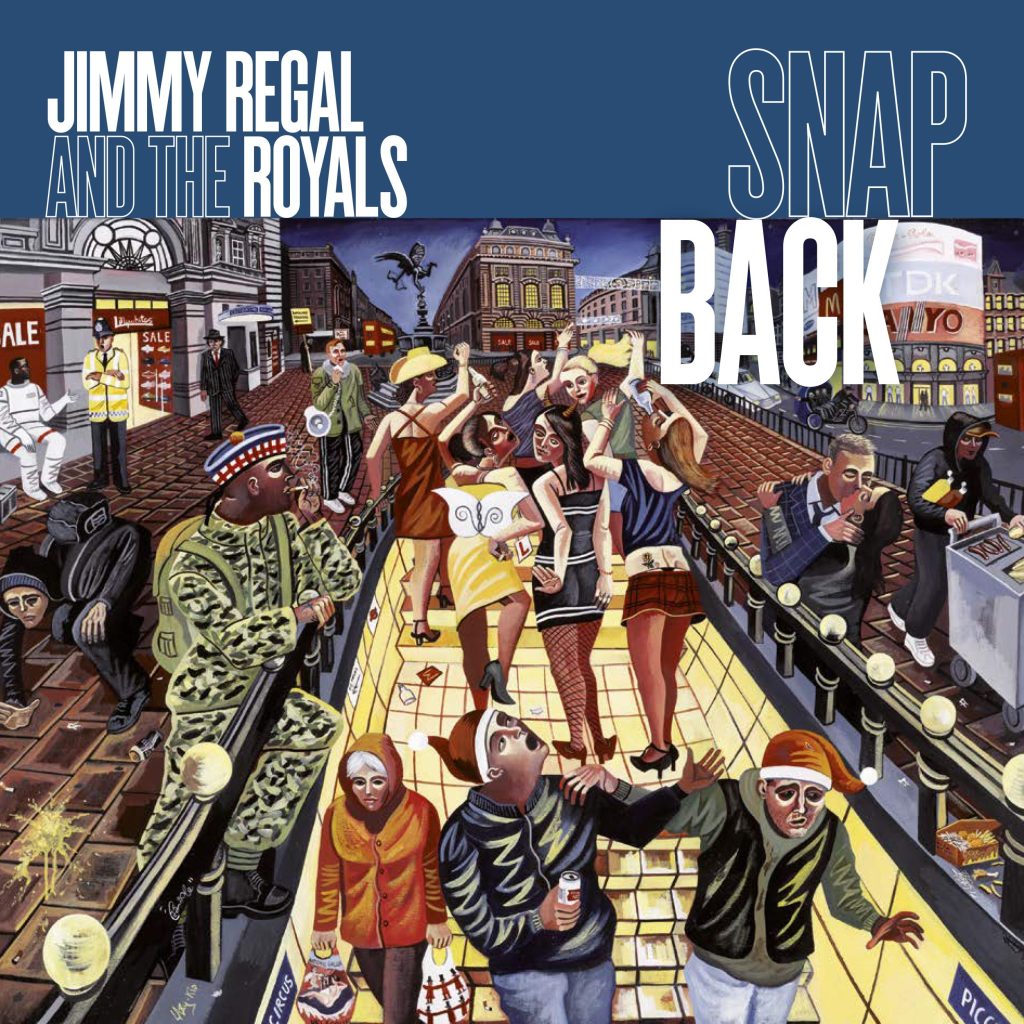
There is no Jimmy Regal. That seems like a reasonable place to start.
Jimmy Regal & The Royals are Joff Watkins on lead vocals, harmonica, and guitar; CJ Williams on guitar, bass duties, and backing vocals; and Sammy Samuels on drums, percussion, and backing vocals. Three musicians sit at the center of Snap Back, yet very little about the record sounds small. Mississippi hill country blues, New Orleans R&B and funk, West African rhythm, jump blues, and South London life all find their way into the same room.
What interested me most was not simply how many influences I could hear, but what the band did with them. Junior Kimbrough and the Burnside family are in the bloodstream. Bo Diddley is there. New Orleans is everywhere. West Africa is part of the rhythmic conversation. But Jimmy Regal & The Royals never sound as if they are borrowing somebody else’s biography. The old music gives them a language; they use it to talk about the places and people they actually know.
That comes through in the 122 bus, a South London betting shop, a dead car battery, an old list of barred pub customers, memories that connect and disconnect, and three musicians who have learned how to leave enough space for one another to make a trio sound much bigger than three people.
I spoke with Watkins, Williams, and Samuels over Zoom on September 24. Before I had even settled into the first question, one of the band members recalled spending one of the best musical weeks of his life in Detroit roughly 30 years ago, living for a few days among musicians and taking in a huge outdoor world-music festival. For a Detroit-area writer, that got my attention quickly. Then we got into the music.

The Interview
When the three of you play, the guitar and harp sound like they are having a conversation, but nobody seems interested in winning it. How did you learn to leave that much space for each other?
CJ Williams: That’s the power of being a trio, I guess. A lot of really great bands, blues and otherwise, with that three-person setup—you have to listen to each other. You have to create space but also fill it as well. We haven’t got a bassist, so I’ve got a two-amp setup with a lower signal going through, and that melds in with Sammy’s bass drum and toms. Sammy uses a lot more toms than I think he probably would in most bands because there’s all that space to let the lower frequencies build up. And because I’m the one doing the chords, I can suddenly switch and do something completely different. I can change songs on a sixpence. I don’t need to look at a piano player or somebody else. I can just do it.
“Snap Back” started with a variation on Junior Kimbrough’s “All Night Long.” Was there a moment when you realized, “This isn’t Junior anymore—this is us”?
CJ Williams: That’s how a lot of stuff gets created, right? You try a riff, you try somebody’s style, and then of course you get it wrong. I can’t sound like anybody. I just fail. I fail really bad. I’d love to, but I just can’t. And then something else comes out and you think, “Well, the timing’s a bit different,” or whatever, and then you go with it. With “Snap Back,” I was very much thinking of Junior Kimbrough and West African influence as well. I’d been doing quite a lot of listening to Ali Farka Touré and Diabel Cissokho. I’ll hear a riff in that music and think it sounds like a North Mississippi riff as well.
“Shining Through on the 122” feels like New Orleans musical language, but the subject is a South London bus. Why was it important to write about your own streets?
Joff Watkins: I go to New Orleans as much as I can, and I just absorb that city. I was there last year. I used to go every year—Jazz Fest, Mardi Gras, French Quarter Fest—and I was obsessed with the amazing different styles and rhythms that meet in the middle. Huey Piano Smith was the inspiration behind that. A lot of New Orleans songs are about New Orleans. Basin Street isn’t a particularly attractive-looking street, but there’s a great song about it. You tend not to do that if you come from the UK; you tend not to shout about it. But there’s no reason why not. We’re not from the United States, we’re not from West Africa, and we’re from South London, so that’s what we write about. London is one of the great music cities of the world. I found myself using the 122 bus quite a lot and thought, “If I were Huey Piano Smith, what would I write about?” It’d probably be that.
Joff, where did the Mickey Two Suits character come from?
Joff Watkins: I did some of my first-ever gigs in South London in a place called The Half Moon pub. Something came up on social media about how, behind the bar, they had a list of customers who’d been barred. There was this list of people: One-Armed Keith, Mickey Two Suits, and quite a few others. We really liked the name Mickey Two Suits. I had this piece of music written, and we decided to name it after him. I’ve met someone who knew Mickey Two Suits, actually. He was a bit of a slippery, shady character. There was an instrumental on our last album called “Mickey Two Suits,” and this time around we were thinking, “What happened to this character? Where did he go?” So there’s this whole kind of story. It’s also got a couple of references to my past life working in betting shops.
“Disconnect” has that wide-open, almost desert feeling. Where did that come from?
CJ Williams: That’s me being inspired by Malian and Senegalese music. We come to this thing where it doesn’t sound like that; it sounds like us, but it’s something in between—a hybrid. I came up with the phrase “urban desert blues.” There’s a whole bunch of songs I write in that mode. With “Disconnect,” there’s a lot of Tuareg and Malian desert-blues influence. To me it has a huge sense of space in it—space and distance and infinite time. It was about memories: how you have little spotlights and bits of your life, and how sometimes they connect and sometimes they disconnect. I was thinking of your internal Sahara Desert.
Sammy, when you move from North Mississippi repetition to New Orleans swing and then a West African pulse, what actually changes in your body as a drummer?
Sammy Samuels: I don’t know if it’s my body that changes so much. It’s about feel. You know you’ve got the groove right when you don’t have to think about it. We’ve played together for about 12 years now, and we understand how we lock in. We’ve got this communication style. I don’t necessarily sit down and say, “This is going to be a clave rhythm,” or, “We’re going to do a New Orleans rhythm.” It just feels good. It feels like what’s right for the song. New Orleans music makes you want to dance, West African music makes you want to dance, and blues music makes you want to dance. I feel like I’m dancing when I’m playing the drums, and that’s when I know I’ve got the right rhythm for it.
On “Hold On Tight,” the arrangement keeps widening and building. How do you keep that from becoming an exercise in showing off?
Sammy Samuels: It’s about understanding our low end, but also the dynamics in the songs: how we bring it down, how we build it up, how we use tempo to change, how we vary a rhythm within a time signature, or occasionally change a time signature as well. One of the enjoyable things is that we don’t rest on our laurels. We’re always trying to find a new way to improve the song, but it’s not about showcasing our talents; it’s about bringing the song to the best possible light. We’ll try whatever it takes to make that work.
On “Don’t Know Diddly,” I hear clean, ringing notes where one note is allowed to speak inside a very busy rhythm. Is that restraint deliberate?
CJ Williams: Very much so. It goes back to us not having a bassist, so I have to play guitar very differently from a traditional band. I’m keeping a bass line going with my thumb or pick and using the other fingers to pick out rhythms. “Don’t Know Diddly” is a case in point: there’s independence between what the bass note is doing and what the rest is doing. There’s a Howlin’ Wolf song called “300 Pounds of Joy,” which I absolutely love. It’s really funky, and I think Howlin’ Wolf was an incredibly funky guy. He’s got clave rhythm, a Bo Diddley beat, and subtle claves intersecting with each other. I thought, “That’s fantastic.” I wanted to try that with the guitar—the bass doing the continuous off-beat thing and the clave on the top strings. That was the genesis of that one.
“Well Boss,” was recorded live. What changes mentally when you know there are no overdubs—do you play harder or listen harder?
Joff Watkins: That song’s always a really tough piece. It was the first song we recorded on the album. We set up and ran it a few times until we got the sound we wanted. That was just live takes. All the basic tracks of the album were recorded live. On the whole, we’re trying to get different dynamics and sounds and variations. You don’t want to play the same way even for one song.
And on harmonica influence—Little Walter has to be in there somewhere, right?
Joff Watkins: If you play blues harmonica, you have to have Little Walter in there because he’s sort of the guy. There are too many people, really, but of course he’s a massive influence on everyone who plays harmonica. I’m still trying to work out some of his stuff. He’s still amazing.
I have to ask the obvious one. There is no Jimmy Regal in Jimmy Regal & The Royals. Where did the name come from?
Joff Watkins: We’d all got together and had a couple of jams, and then a gig came up at very short notice. But we didn’t have a name. I just had it in my mind that I wanted to have a band called Jimmy Regal & The Royals. I don’t know why. I just thought, “That’s a cool-sounding name.” Just before we went on, I said, “How about this? Why don’t we call ourselves Jimmy Regal & The Royals?” And that was it. We became Jimmy Regal & The Royals. It’s not named after any of us. It just had a ring to it. People often ask us, “Who’s Jimmy Regal?” And we say we all are, basically. That’s the standard response.
A quick note after the interview: the conversation confirmed something I had already heard in the record. These three are not trying to build songs around individual hero moments. The trio works because they listen, answer, leave space and bring in guests when the song genuinely needs another color. That makes the album’s wide geography feel less like a checklist of influences and more like a living musical vocabulary.

The Album Review
Some records make you want to study where every sound came from. Others make you want to move. Snap Back manages to do both. There are moments here that give you every reason to jump, jive and wail, others that settle into an easy groove you can sit back with in the living room, and faster tunes with enough swing and harp to sound made for the radio. That range is a big part of why the album works.
The more time I have spent listening to Mississippi blues and talking with musicians who live inside that tradition, the easier it has become to hear family resemblances without confusing influence for imitation. That matters here. Junior Kimbrough and the Burnside family are in the bloodstream. Bo Diddley is there. New Orleans is everywhere. West Africa is not decoration; it is part of the rhythmic conversation. But the important thing is that Jimmy Regal & The Royals keep bringing all of it back to their own lives in South London.
“Don’t Know Diddly”
This may be the best old-sounding track on the album, which is fitting for a song built around Bo Diddley history. The beat has that instantly recognizable Diddley push, but underneath it is an African rhythmic feel that keeps it from becoming a simple throwback. Williams’ guitar is the hook for me: clean, ringing single notes sit inside a busy rhythmic architecture, while the bass movement and upper-string patterns work independently. After hearing CJ explain the link to Howlin’ Wolf’s “300 Pounds of Joy,” clave and overlapping rhythmic patterns, the track makes even more sense. It sounds old without sounding dusty.
“Shining Through on the 122”
This one slides farther into funk, soul and R&B. The starting point is Huey “Piano” Smith and 1950s New Orleans rhythm and blues, but the song belongs to the band’s own South London world and the 122 bus. That is the point. They borrow musical vocabulary without borrowing somebody else’s biography. Layered harmonicas and extra percussion widen the groove, but what sticks with me is Joff’s explanation: if New Orleans writers can sing about their streets, why shouldn’t three South London musicians do the same?
“Snap Back”
This is the one for me. The title track has the strongest combination of swing, grit and forward motion on the album. The main riff began as a variation on Junior Kimbrough’s “All Night Long,” but it evolved into something that feels like its own song rather than an exercise in hill country blues. The guitar has that Kimbrough-like repetition and distortion — a tight loop that feels like a coiled spring — while Watkins comes over the top with a killer harp swing. Lyrically, it is about getting hit, standing up and going again. The riff keeps returning, but every return feels like another push forward. My favorite track on Snap Back.
“Disconnect”
The violin changes the room immediately. Kamila Bydlowska brings a different emotional color while Watkins’ harp, djembe, percussion and guitar create a broad, open space around the song. Williams calls this side of his writing “urban desert blues,” and after the interview I understand the phrase better. The track is about memory, the pieces that connect and the pieces that do not, and what he described as an “internal Sahara Desert.” Musically, everyone wanders, but nobody loses the others.
“I Wanna Be On Your Radio Show”
This is one of the lighter, quicker songs, with swing in the beat and Watkins’ harp moving all around it. The idea started as a radio-jingle concept inspired by Johnny Sansone and WWOZ in New Orleans, then expanded into a full song. In plain language, the message feels like: I need to get my ass out there. People need to hear what I am doing. It is catchy, loose and easy to imagine coming out of a car radio with the windows down.
“Don’t Try”
This is darker and calmer. The guitar gets lighter, the swing settles down and the lyrics turn inward. The title comes from the words on Charles Bukowski’s gravestone and the idea that real creative work cannot simply be forced into existence. It is not one of my favorites on the album, but it earns its place because the record needs a song willing to sit still for a while. Different strokes for different folks — somebody else may connect with this one more than I did.
“Hold On Tight”
The title is basically instructions. Rolling drums, a swinging jazz pulse, soul, horns and percussion keep building until the song feels ready to come off the rails without actually doing it. This is one of the places where Samuels really stands out. There is a cool swamp-boogie groove underneath the larger arrangement, and the coda keeps widening toward a long Fela Kuti-inspired build. Sammy’s interview answer gets to the heart of it: the rhythmic changes are not there to display chops; they are there to put the song in the best possible light.
“Until I Die”
Here the record gets back into the dirt. Distorted guitar, repetition and open space give it that hypnotic North Mississippi pull. Junior Kimbrough and the Burnside family are the clearest reference points to my ear, while the band’s own shorthand is West Africa meeting North Mississippi. What I hear emotionally is persistence. Keep going. Keep playing. Keep pushing on until you cannot anymore. The groove keeps circling the same ground without feeling stuck.
“Flat Battery Blues”
This is one of the most traditionally bluesy stories on the record, and maybe that is why I like it so much. A man is stuck, the car will not start, the woman is somewhere else, and the dead battery is literally keeping them apart. That is blues songwriting at its best: take an ordinary aggravation and make it feel universal. There is rough Mississippi twang in the guitar, with the band’s notes also pointing toward funk and Cedric Burnside. Sometimes you do not need tragedy, betrayal and a train leaving town. Sometimes the damn battery is enough.
“What Mickey Did Next”
This is the oddball. Harp comes in early, the beat moves quickly and the arrangement keeps adding things until it feels as if the band has thrown a handful of ideas into the room to see which ones survive. I did not connect with it as strongly as the best songs on the record, but the interview gave the track more weight. Mickey grew from the name of a real person on a barred-customer list at a South London pub, then picked up pieces of Joff’s years around betting shops and local characters. A neat, tidy arrangement probably would have been the wrong music for him anyway.
“Well Boss”
If you want the shortest explanation of why Watkins matters to this band, finish the record here. “Well Boss” is a full-throttle harmonica instrumental recorded live, and it lets the trio play like three people arguing happily in the same room. Watkins’ harp and Williams’ guitar go back and forth, but again neither player seems interested in winning. Samuels keeps the groove centered. Little Walter is easy to hear in the amplified attack, while the band’s stated inspirations include Big Walter Horton and Rod Piazza. The larger point is that Watkins uses the harmonica as singer, horn, rhythm instrument and sparring partner — and he swings all of it.
The Bigger Picture
Snap Back works because Jimmy Regal & The Royals understand that loving old blues does not require freezing it in place. Mississippi hill country blues, New Orleans R&B and funk, West African rhythm, jazz and jump blues are all in the record, but the album becomes more interesting when those histories run into the band’s own lives: the 122 bus, a South London betting shop, a dead battery, memory, ambition and the simple act of getting back up after being knocked down.
Not every experiment lands equally for me. “Don’t Try” and “What Mickey Did Next” sit lower on my personal list, while “Snap Back” is the clear high point. That is part of being honest about a record. I would rather hear a band try eleven different things and miss me twice than make eleven versions of the same safe groove.
For three people, Jimmy Regal & The Royals make an outsized sound. More importantly, they make it without losing the conversation between the players. Nobody seems desperate to prove he is the star. They listen, answer and leave space. That may be the most traditional blues value on the whole album, even when the music is traveling from Mississippi to New Orleans to West Africa and back to South London.
They take the old blues and R&B language and make something new and bright out of it without losing their love for the music underneath. You can hear the old road, but you can also hear three people living now. That is why Snap Back works for me: the band knows exactly where the music came from, but they have no interest in staying there.
Snap Back receives its physical release September 25, 2026, followed by its digital release October 2, 2026.
*
Love what we do? Rock the Joint Magazine is completely free—no paywalls, no ads ruining the vibe—just passionate music journalism for 1,000+ readers a day. If you enjoy hanging out with us, please consider hitting the “Support Us” button and buying us a coffee on Ko-Fi. Even a small donation genuinely helps keep the magazine running, lets us publish more features, and reminds us that people value independent music writing—it’s nice for us to feel appreciated too!
Artist Website here
Stream music from Jimmy Regal and the Royals here
By Chad Cubberly
Join Rock the Joint Magazine on the road to the best independent music journalism, interviews, and reviews. We cover Rock, Country, Jazz, Blues and Christian music. Support us on Ko-Fi (link on each page) to help the magazine grow and value independent journalism.