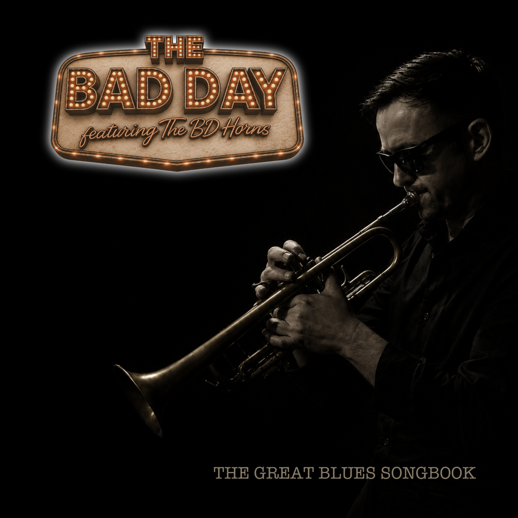
Recorded in a single day and captured on film, the London six-piece revisits ten standards with clean horns, room to breathe, and enough modern muscle to keep the songs moving forward.
The Bad Day featuring The BD Horns
Adam Rigg – bass/vocals | Martin Jackson – guitar | Stephen Brown – drums
Vera Butler – alto sax | Dom Thatcher – baritone sax | Martin Leach – trumpet
“The Great Blues Songbook” – November 13, 2026 – Crackerjack Records UK
The blues has never stayed alive by standing still. It has been borrowed, bent, electrified, sped up, slowed down and carried into soul, rock, R&B, jazz and nearly every corner of roots music. That is why a record like The Great Blues Songbook works best when it is not treated as a museum exercise. The point is not to copy the past perfectly. The point is to understand it well enough to keep it moving.
That is exactly the challenge The Bad Day featuring The BD Horns take on here. The London band entered Punch Studios in Ipswich with producer Craig Smith on April 4, 2026, and recorded the entire album in a single day, deliberately taking inspiration from the famously compressed recording approach behind The Beatles’ “Please Please Me.” That choice matters. These songs were built on feel, chemistry and musicians reacting to one another, and the one-day approach gives this record a sense of musicians being in the room together rather than assembling a tribute one polished layer at a time.
Seeing that day unfold in the accompanying documentary adds another dimension to the record. Filmed by George Say, the black-and-white presentation is a smart choice: it gives the session a little of the visual nostalgia of the blues past without pretending the music itself belongs there. Punch Studios has an identity of its own on camera – a working room with atmosphere rather than a faceless recording space – and watching the band build the album there makes the professionalism behind the finished record even clearer. Recording ten songs in one day leaves nowhere to hide. Rigg has to sing and play, Jackson has to have the guitar language under his fingers, Brown has to hold the room together, and the horns have to arrive clean and together. Watching them do it makes the musicianship, preparation and plain hard work behind the album impossible to miss.
The other major piece of the story is the horn section. The current six-piece lineup pairs Adam Rigg on bass and vocals, Martin Jackson on guitar and Stephen Brown on drums with Vera Butler on alto sax, Dom Thatcher on baritone sax and Martin Leach on trumpet. Across these ten tracks, the BD Horns are not decoration. They answer the vocals, push the arrangements, fill empty spaces and, at their best, become another voice in the band.
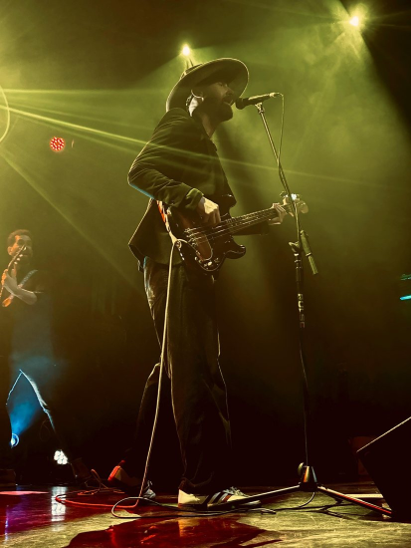
Adam Rigg on bass and vocals. Press photo supplied with the album materials
The album announces itself with Otis Redding’s “I Can’t Turn You Loose,” and it is a terrific choice. The song’s long association with The Blues Brothers makes the opening almost visual: once those horns hit, you can practically picture Jake and Elwood making an entrance. But the performance never feels like novelty. The horns are clean, the rhythm section has punch, and the recording captures a strong soul-blues sound right out of the gate. It is the kind of opener that tells you immediately that this record intends to move.
“Let the Good Times Roll” feels like an extension of that entrance, only with more swing in its step. The band understands when to pull back, letting Rigg land a vocal line before the instruments come rolling back in. That use of space gives the performance a little of the dramatic stop-and-start instinct I associate with Muddy Waters and classic Chicago blues. Jackson’s guitar bends and hangs on notes rather than simply racing through them, with a touch of B.B. King in the phrasing. The important thing, though, is that this is a full-band track. Everybody gets room, and the result feels less like a cover than a genuine blues revival.
“Everyday I Got the Blues” comes out brighter than the title suggests. It has a lively swing, quick guitar work and the kind of rhythm that makes sitting still difficult. I first thought of the energy of “Jump, Jive an’ Wail,” not because the arrangement copies it, but because it has that same get-up-and-move quality. It is blues with a smile on its face, a short, sharp toe-tapper that keeps the early part of the album moving.
Then “Mr. Pitiful” changes the temperature. The arrangement is leaner and there is less crowding the vocal. Rigg changes his delivery too, singing in a more conversational style while the horns work almost like backing singers. He throws out the line; they answer. That call-and-response is one of the coolest details on the record because it shows how fully the BD Horns have been integrated into the band’s sound rather than simply added on top of it.

The Bad Day featuring The BD Horns – current six-piece lineup. Press image.
The middle of the record slows down and, in doing so, gives some of its best playing more room to speak. “How Blue Can You Get,” forever tied to B.B. King, has a late-night nightclub feel from the opening guitar notes. The guitar seems to melt into the song, leaving air around each phrase, and the lyric is pure downhearted blues: being left, knowing it, and having nowhere to hide from it. The guitar talks, but so do the horns. They answer and underline the emotion like another voice in the conversation. Nothing needs to rush. The feeling is in the space between the notes.
“Sweet Home Chicago” gets one of the record’s most modern treatments. I will admit to one small blues-nerd disappointment: I miss Robert Johnson’s wonderfully strange “land of California” lyric. Rigg sounds excellent, though, and there are moments in the smoother vocal phrasing that even give me a little Michael Bublé. The production is warm and clean, and once again every instrument gets a turn without anyone being buried. It is a respectful homage to the old blues players, but it is not trying to pretend it was recorded in another era. That may be exactly why a younger listener could hear this version and then go looking for where the song came from.
“Rock Me Baby” makes the blues-to-rock connection almost impossible to miss. This is the kind of song you can imagine Led Zeppelin or the Rolling Stones finding and immediately wanting to turn louder. The drums and vocals lead from the front until the guitar steps in with that familiar B.B.-style economy, supported rather than crowded by the horns. The Bad Day add some rock muscle without losing the blues underneath it, which is a pretty good reminder that so much classic rock was built from this exact foundation.
“Sweet Little Angel” heads back toward a 1950s club atmosphere. Rigg spends much of the performance somewhere between singing and talking, which makes the lyric feel personal rather than theatrical – a love letter to a woman he needs badly. The horns remain soft until they need to flare, and the guitar uses those gentle B.B. King-style tones that say more with a few notes than a wall of sound could. It begins slowly, almost understated, but keeps building until it becomes one of the album’s most complete blues performances. This one pulls you in rather than grabbing you by the collar.
“Hold On, I’m Comin’” brings the soul and funk back to the front. There is a little James Brown punch in the way the rhythm hits, but the heart of the song is still Sam & Dave and that Stax tradition. The horns make the track, punching in at exactly the right moments while Rigg’s bass sits underneath with a strong backbeat. The band sounds loose, confident and locked together. Sometimes the best compliment is the simplest one: this track moves. Big Joe Turner’s “Flip, Flop and Fly” is a smart way to leave. Rather than repeating the exact feel of the earlier swing numbers, it plays like the band walking you toward the door while the party is still going. The call-outs to the different instruments are a nice touch, almost giving everyone one final introduction before the lights come up. The album entered with movement and it exits the same way.
That sequencing helps The Great Blues Songbook feel like more than ten familiar songs sitting next to one another. It begins with a soul-blues entrance, swings through jump blues and Chicago space, settles into late-night B.B. King territory, connects those sounds to rock and Southern soul, then sends you out moving. The one-day recording idea could easily have been a gimmick, but the performances make it useful: you can hear the band responding to each other, and the occasional rough edge or open space is part of the point. The documentary reinforces that impression because you can actually watch those decisions happen in the room. What sounds effortless on the record is the product of players who know their instruments, know the material and came prepared to make the day count.
More importantly, the album understands something basic about tribute records. Honoring the blues does not require preserving it in exactly the form in which an earlier generation played it. The blues became the backbone of so much later music because musicians kept carrying it forward – into soul, rock, funk, jazz and whatever came next. Doing that with respect, even in a different style or with modern production, is still a tribute to the people who built the language in the first place.
The Bad Day are not replacing the definitive versions of these songs, and they do not need to. What they do well is give the songs another room to live in. The horns give the band a stronger identity, the recording keeps enough air around the performances, and the best moments sound like musicians enjoying the same discoveries that generations before them made. The Great Blues Songbook looks backward, but its real value is that it keeps the music pointed forward.
*
If this feature struck a chord, why not explore more of what we do? From exclusive interviews to reviews, editorials, poetry, and our own merch—there’s plenty to discover. We put a lot of heart into every piece, and if you’d like to show a little love in return, you can support us with a small donation via the Ko-Fi link below. Every coffee keeps us going—and helps keep the magazine free for all. Thank you!
Artist Website here
By Chad Cubberly
JOIN ROCK THE JOINT MAGAZINE ON A JOURNEY FOR THE BEST IN INDEPENDENT MUSIC JOURNALISM – WE COVER ROCK, COUNTRY, JAZZ AND CHRISTIAN MUSIC. LEADING FEATURES, INTERVIEWS, REVIEWS AND EDITORIALS. SUPPORT US ON KO-FI.