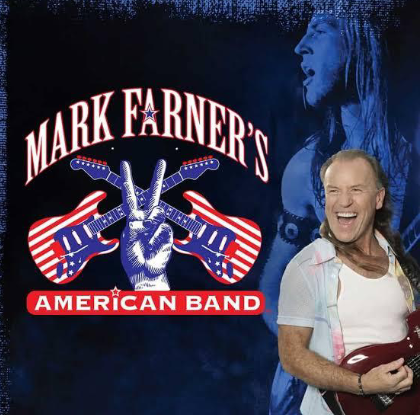
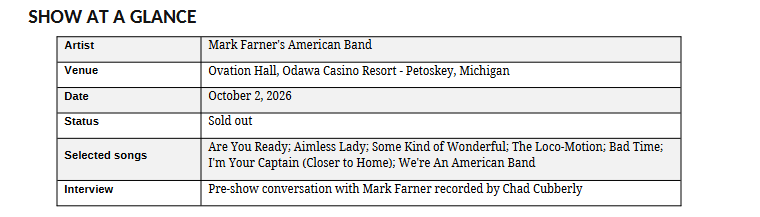
Some artists come home and spend the night looking backward. Mark Farner came home to Michigan and sounded like a guy who still had something to prove. Three days after his 78th birthday, Farner brought Mark Farner’s American Band to Odawa Casino’s Ovation Hall in Petoskey on October 2, 2026. The show was sold out well before he walked onstage. Farner’s own website had already thanked the state with a simple line: “Thank you Michigan! Way to bring it home!” By the end of the night, that felt less like promotion and more like the theme of the whole evening.
Before the show, I asked what it still means to play his home state after a lifetime of touring. He did not answer with statistics or nostalgia. “It’s special to me because this is my first stomping ground. This is where I learned how to stomp.”
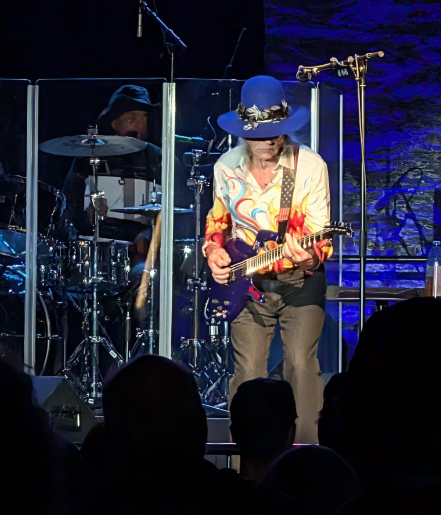
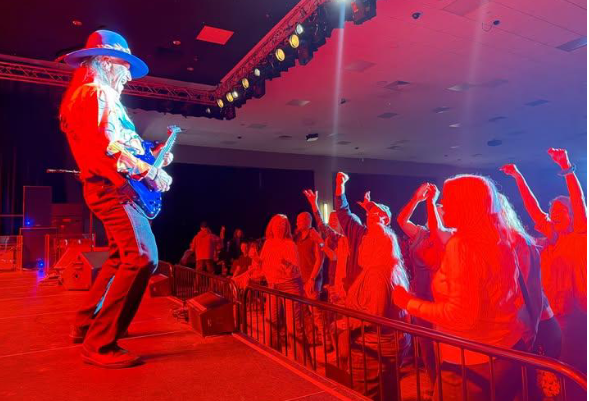
Mark Farner onstage in Petoskey. Live performance image supplied by Chad Cubberly
That answer opened the door to Dick Wagner’s Bossmen, the MC5, Iggy Pop, the Rationals, Detroit and Flint radio, R&B, Motown, family music and the working people who brought different sounds north with the auto industry.
Michigan, in Farner’s telling, was not simply where he happened to grow up. It was the place that mixed the ingredients.
The Michigan Sound Was Already in the Room
Farner’s explanation of Michigan rock is less about one genre than collision. Motown, R&B, garage rock, hard rock and blues all lived within radio range of one another.
He spoke about CKLW, WRIF, WTAC and the stations that fed him Black music and rock music side by side. He also talked about family jams and relatives who came north for auto work. That mix became part of his musical vocabulary.
“That’s how the funk got in my music, man. I’m a dancing fool.”
That line may be the cleanest explanation of the Mark Farner guitar style I heard all night. His playing has always lived between rhythm and lead. He can hit a riff like a rhythm guitarist, answer his own vocal like a lead player and keep the song moving underneath both. Technique matters, but so does the physicality. Farner’s guitar playing expects the rest of the body to participate.
Closer to Home Still Means Home.
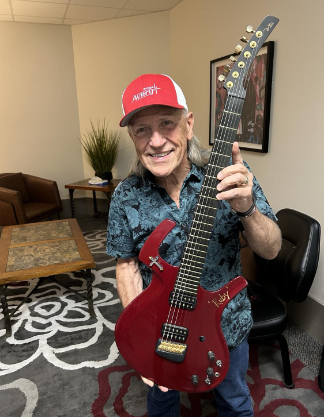
Farner with “Ruby,” the spare guitar he had with him in Petoskey. He told me “Betty” would get the work that night; “Baby” stayed home. (Photo by Chad Cubberly).
I asked Farner whether “I’m Your Captain (Closer to Home)” feels different when he sings it in Michigan now than it did when he wrote it as a young man. His answer came fast.
“Yeah, man. I wrote it here.”
He placed the writing in Parshallville, near Hartland. That matters because “Closer to Home” has spent more than half a century traveling far beyond Michigan. Listeners have attached it to their own wars, departures, losses and returns. But for the man who wrote it, the phrase still has geography attached to it. That changed the way I heard the song later that night. When Farner reached “I’m Your Captain,” it was no longer just the expected classic in a legacy set. Minutes earlier he had reminded me that the song started here. Now a sold-out Michigan room was singing it back to him.
The Songs Are Old. The Performance Isn’t.
If you show up to a Mark Farner concert looking for nostalgia, you are obviously going to get some. These songs have fifty-plus years of memory attached to them. But the room did not behave like a museum, and Farner did not play the set like one.
The Grand Funk-heavy core of the night moved through “Are You Ready,” “Aimless Lady,” “Some Kind of Wonderful,” “The Loco-Motion,” “Bad Time,” “I’m Your Captain (Closer to Home)” and the unavoidable anthem “We’re An American Band.” The interesting part is how much of the backstage conversation could be heard in the music. “Some Kind of Wonderful” and “The Loco-Motion” bring the R&B and dance side right to the surface. “Bad Time” reminds you how much melody always lived inside this supposedly heavy catalog. And “Closer to Home” still has the emotional reach to quiet a room before it lifts it again.
Farner came out in a wide-brimmed blue hat and a flame-pattern shirt and spent the night leaning into the guitar rather than posing with it. His voice has age in it now – and it should. The better question is whether it still carries authority. It does. There is grain in the vocal, but also conviction, and the guitar remains soulful, physical and immediately recognizable.
The crowd response made the point better than any career summary could. Fists went up, people sang, and the front of the room looked less like an audience politely honoring history than a group of people still using these songs in the present tense.
That is especially true of “We’re An American Band.” Whatever complicated history surrounds the larger Grand Funk catalog, the song itself has long since escaped its era and become American rock shorthand. In Petoskey it did what an anthem is supposed to do: turn a room full of separate people into one loud thing for a few minutes.
Not a Museum Piece
One of the more interesting parts of talking with Farner is how little interest he has in presenting himself as a preserved piece of 1970s rock history. His current work still leans toward social conscience, and in our conversation he reached back to “Social Disaster,” a song he wrote in 1977, while talking about prison work, personal responsibility and the possibility of people becoming examples instead of repeating the same cycle.
His more recent album “Closer to My Home” makes the same point. He is not pretending the past does not matter; he is refusing to let it be the only thing that matters. At 78, he does not need to pretend he is 28 either. What matters is whether he can still walk onto a stage, plug in and make the songs feel necessary to the people standing in front of him. In Petoskey, he did.
That is why Mark Farner’s American Band works as more than a nostalgia trip. There is certainly celebration in hearing songs that have survived generations, but the stronger feeling is continuity. The voice is still unmistakable. The guitar still has that rhythm-and-lead push. The stage presence still feels personal rather than distant. And the connection with the crowd is not based only on remembering what these songs once meant – it is based on what they still mean when everyone in the room is singing them together.
The Guitars Have Names for a Reason
Before the concert, Farner showed me the guitars he had brought to Petoskey. “Betty” was the one he planned to play. “Ruby” was the spare. “Baby” stayed home. All three are hardtails – no whammy bars. It is a small detail, but it fits the way he approaches the instrument: direct, physical and built around his hands rather than effects doing the talking for him.
Ruby, in particular, looks like a working guitar rather than a museum object. The instrument has personality before a note is played, which is probably why naming them does not feel like a gimmick. Farner’s guitars are not accessories to the show. They are part of the vocabulary.
What “Home” Sounds Like
The easiest way to write about Mark Farner is to begin with Grand Funk Railroad, the records, the big venues and the songs that became part of classic-rock radio. All of that is true. It is also the least interesting thing about meeting him in Petoskey in 2026.The more revealing story is smaller: a Michigan musician talking about the bands he watched before anybody knew his name; family members making music on Sundays; Black radio and rock radio crossing paths; factory migration changing the sound of a state; a guitar language built from all of it; and a song called “Closer to Home” that still means exactly that. More than fifty years after those songs first found their audience, Farner still has enough voice, guitar and personality to make a sold-out room respond in the present tense. That is the difference between replaying the past and carrying it forward. His website celebrated the sellout with “Way to bring it home.” After the interview and the show, the phrase landed differently for me. Home, in Mark Farner’s music, is not just a destination. It is the source. And three days after turning 78, he was still plugged into it.
*
Love what we do? Rock the Joint Magazine is completely free—no paywalls, no ads ruining the vibe—just passionate music journalism for 1,000+ readers a day. If you enjoy hanging out with us, please consider hitting the “Support Us” button and buying us a coffee on Ko-Fi. Even a small donation genuinely helps keep the magazine running, lets us publish more features, and reminds us that people value independent music writing.
*
Editorial note: Interview quotations are drawn from the author’s recorded pre-show conversation with Mark Farner at Odawa Casino on October 2, 2026. Public event and historical context were checked against Odawa Casino, MarkFarner.com and prior Northern Michigan coverage. Live images were supplied by Chad Cubberly; the Ruby photograph is by Chad Cubberly.
Artist Website here
By Chad B. Cubberly
Join Rock the Joint Magazine on the road to the best independent music journalism, interviews and reviews. We cover Rock, Country, Jazz, Blues and Christian music. Support us on Ko-Fi (link on each page) to help the magazine grow and value independent journalism.