At 85, the folk-blues pioneer is heading back to London for his first concert there since the 1960s — bringing new songs, a lifetime of musical connections, and the same instinct that helped great songs find their way into the world.
Tom Rush laughs when he is asked what he remembers about playing Britain in the 1960s. “It goes so far back,” he says. “This is my 68th annual farewell tour.” That dry line tells you quite a bit about Rush. At 85, he is not interested in being treated like a museum piece. He is still touring, still writing, still recording, still listening for songs, and on November 1 he will walk into London’s Union Chapel for what the venue bills as his first Londonconcert since the 1960s.” I’m looking forward to it,” Rush told Rock the Joint from the United States on October 14. “It’s been way too long. I’m excited to be doing a show for the folks there. I’ve got all kinds of family and college buddies coming, and hopefully a lot of people who just want to hear me sing and tell stories.”
The memories of those first British trips arrive in flashes. Rush remembers Cambridge Folk Festival appearances and a manager who, as he puts it, “didn’t believe England existed” until Rush changed management and suddenly found himself crossing the Atlantic regularly. He also remembers Bob Dylan arriving for a British press conference with a bottle of water in one hand and a pound of butter in the other, refusing to answer questions while the press tried to decode the gesture. Rush’s conclusion is less mystical: “No, it means he’s screwing with you.”
The November return will be solo, which may be the purest way to see Rush anyway: voice, guitar,stories, and the accumulated confidence of a performer who learned decades ago that holding aroom has less to do with volume than with attention.
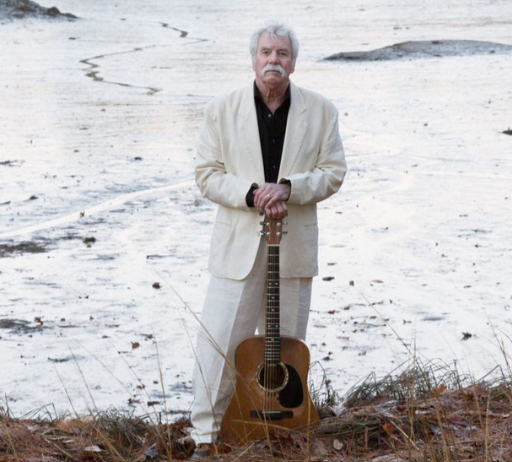
“No Regrets”
A British Life for “No Regrets.” If there is one song waiting for Rush when he gets back to London, it is “No Regrets.” He wrote it early in his career — he believes it was only the third song he ever wrote — but in Britain it took on a life of its own.
The Walker Brothers turned it into a major UK hit in the mid-1970s; Midge Ure later recorded it as a solo single; and the song kept traveling through other singers and styles long after Rush had largely disappeared from British stages. Rush still sounds amused by the way that happened. “I think they just did my song,” he says of The Walker Brothers. “A bunch of people had already done it — Emmy Lou Harris and a bunch of people in the States — and I think that’s where they got it. Their version was actually quite similar to my second recording of the song. “Then came more versions: a heavy-metal take that Rush jokes was so ponderous the singer only managed two verses in eight minutes, and a hip-hop version he did not even recognize when someone played it for him. U2 also worked “No Regrets” into live performances. Rush remembers reading an interview in which Bono was asked about the song and responded by praising Scott Walker. “I’m like, ‘Excuse me, over here,'” Rush says. The two eventually met before a show in Phoenix. “He apologized, and I forgave him.” For London, that history gives the song a special weight. Rush is not simply bringing an American oldie back across the Atlantic. He is returning to a country where one of his songs spent decades developing a second identity without him.
New Songs, Not a Victory Lap
That matters because Rush is not coming back with only the old catalog. “Gardens Old, Flowers New,” released in 2024 and produced by longtime collaborator Matt Nakoa, is a 14-song record built almost entirely from Rush’s own writing. For a musician famous for recognizing important songs by other writers, the album flips the familiar story around: this time, the interpreter brought plenty of his own material. “I’ve done more writing in the past ten years than in the first fifty years,” Rush says. He dates his professional clock to the summer of 1959, when he was street singing in Europe. London was not immediately encouraging — “People would actually cross the street to avoid me” — but Paris was kinder, and the career kept moving. On the new record, Nakoa helped turn a pile of finished songs into an album. “He pushed me in that direction,” Rush says. “They were all songs that were already written. I didn’t have to fill in any blanks or him. I think it’s my best yet.” What especially pleases him is that listeners rarely agree on the same favorite. “Everybody seems to have a different favorite song, which I find encouraging.” For this interviewer, “Gimme Some of It,” a track with a hypnotic blues pulse, strong piano and harp, and Rush’s half-sung, half-spoken delivery riding over the groove is a real favorite. Rush says the song grew from versions he had heard from blues performers over the years before he shaped it into his own.
“My job is to try to catch one before it zooms away again.”
Ask where songs come from, though, and Rush abandons musicology for astronomy. “My vision is that out at the edge of the solar system there’s a cloud of songs, kind of like the comets, and they come zooming through,” he says. “My job is to try to catch one before it zooms away again. “The record’s early stretch shows why the title fits. “Sailing” opens with airy acoustic space and a light country feel. “Glory Road” is a rambling-man song that eventually points back home. “Nothin’ But aMan” leans into slide and plain spoken limits, while “Lullaby in E” gives Rush’s acoustic playing room to breathe. “One More Time Around the Sun” carries an almost Celtic folk-ballad feel before landing like a raised glass in a crowded room.
For “Glory Road,” the homeward pull was not abstract. Rush wrote it while living in Derry, NewHampshire, when he was already tired of too much time on the road. Decades later, that feeling has returned. He had just come back from Colorado when we spoke and was preparing for Texas and then England. “I think I might need to take some time off and write a book or something,” he says, before adding the more realistic alternative: “Maybe just take a lot of naps.
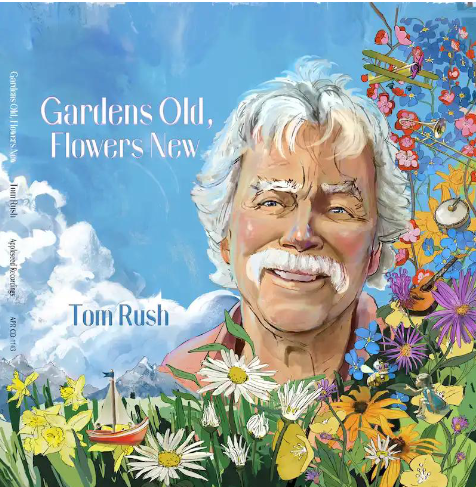
Gardens Old, Flowers New (2024).
Detroit, Joni Mitchell and the “Goosebump Factor”
The most famous part of the Tom Rush story begins in Detroit, and from Michigan it still feels remarkable. Rush was playing the ‘Chess Mate’ when a young Joni Mitchell came in and asked to perform a guest set so he could hear some of the songs she had just begun writing. Rush’s explanation for why he chooses songs is simple: “the goosebump factor.” If a song gives him a physical reaction, he wants to carry it. “Some songs give me goosebumps that I shouldn’t even touch because they’re just too far out of my reach,” he says. At the Chess Mate, Mitchell gave him that reaction. Rush remembers playing there for two weeks every summer. The club was run by Morrie Widenbaum, Michigan’s chess champion for years. It had originally been designed as a place to play chess before becoming a music room, hence the name. Mitchell had been appearing there with her then-husband, Chuck Mitchell, doing traditional folk material. But she had started writing her own songs. “She got up and did four songs,” Rush remembers. “Totally knocked my socks off.”
Rush was already overdue delivering an album to Elektra and needed material. He asked if she had more. She did not — yet. A month or two later, she sent him a tape containing six songs. Before the last one, Mitchell apologized for it, telling him she had just finished it, that it was not very good and that she was embarrassed by it. The song was “The Circle Game.” Rush named an album after it. “I’ve found this to be true,” he says. “Songwriters sometimes don’t know what the good ones are.” One of the four songs Mitchell had played for him in Detroit was “Urge for Going,” a song Rush still performs. “Especially this time of year with winter coming on,” he says. Rush’s ear did not stop with Mitchell. “The Circle Game” album also brought early songs by James Taylor and Jackson Browne to a wider audience. ‘Rolling Stone,’ Rush jokes, once “accused me of ushering in the singer-songwriter era. They never proved anything. I was never indicted.” He is careful not to inflate his role in Mitchell’s story, but he knows he helped. He took her on the road for a time so she could play for more people, at a moment when not everybody around her understood what she was doing. “I think I was helpful in the early stages,” Rush says. “And she certainly was helpful to me because she provided me with some absolutely stunning songs.”

Gordon Lightfoot, Open Tunings and Holding a Room
Rush’s reputation as a live performer has always depended on more than repertoire. Gordon Lightfoot once brought him to Toronto to open the first two nights of Lightfoot’s return to the renovated Massey Hall after a broken wrist forced Lightfoot to shorten his own sets. Rush remembers it as a huge honor — and as an opportunity for a joke. Lightfoot introduced him by noting that Rush had been early to record Mitchell, Taylor and Browne, then added: “But he never recorded any of my songs.”
Rush walked onstage and answered that he had thirty minutes that night and thirty minutes the next, so perhaps he could do the first half of “The Wreck of the Edmund Fitzgerald” on night one and finish it the following evening. The crowd liked it. That exchange also gets at what Rush believes a live room needs. “For me, that’s the fun part,” he says of the connection between performer and audience. “The audience responds to that. It’s what happens in between the songs.”
The storytelling began as a practical solution. When Rush was learning open guitar tunings, changingfrom standard tuning could take long enough for audiences to start checking their watches. So he filled the dead air with stories. Eventually, listeners began asking for the stories by name.
“That’s the way I look at it. I’m narrating the songs.”
Songs and stories are not separate jobs to Rush. “That’s the way I look at it,” he says. “I’m narrating the songs.” He tries to create the same feeling on record. “I’m trying to get your attention. I’m trying to get you to listen. Pay attention. This is a good song. This is a good story going on here.” That philosophy should suit Union Chapel. The London show will be solo; his recent accompanist Brendan Cleary is staying home because this trip is built around one main concert. In a room designed for attention, Rush will have exactly what he has always needed: a guitar, an audience, andenough space between songs to tell them why they should keep listening.
Club 47 Comes Around Again
The most interesting new development Rush shared has little to do with looking backward. It starts with Club 47, the Cambridge coffee house one block from his Harvard dorm that, by his own account,nearly caused him to flunk out.
Club 47 put young musicians in the same small room with established masters. Rush remembers the Carter Family, Flatt and Scruggs, Bill Monroe and old blues players coming through. In an 80-seat club, those musicians were not remote legends. “You could go up to Sleepy John Estes and ask him, ‘How do you do that thing you do?'” Rush says. “And he would tell you. He would show you.” After the original club closed, Rush later used the Club 47 name for concert series that paired established performers with younger artists. Now that idea may be headed for television. Rush says Joe Spaulding is leading a project to turn Club 47 into a public television series. Funding and guests are in place to record a pilot episode in early December, although there is no broadcast date yet. Rush would host.
The model is straightforward: bring in an established artist and have that artist introduce a younger musician they believe deserves a wider audience. Emmy lou Harris, Rush says, is among the artists who wants to take part. The idea matters to him because he sees how much harder the path has become for emerging musicians. He points to Cleary, whom he first heard playing in a Boston bar. “This kid’s too good to be playing in bars,” Rush remembers thinking. Cleary was considering leaving music to train as an airline pilot. Rush brought him into his own shows instead. “I came along and ruined everything,” he jokes. Behind the joke is a real concern. Record companies once got young artists on radio, supported toursand helped create enough visibility to build a career. “That doesn’t work anymore,” Rush says. “It’s all online now, and 20,000 plays on Spotify might buy you a cup of coffee.” His worry is not nostalgia for the old business so much as the talent that may never survive the newone. “I’m afraid some really talented monster talents are going to go to work for the supermarketbecause they can’t afford to keep going,” he says. He hopes the Club 47 television idea can help change the odds for at least a few of them.
The Old Garden, the New Flowers
Rush was inducted this year into the Folk Americana Roots Hall of Fame alongside Jackson Browne, Judy Collins, Neil Young and a remarkable class of artists whose names sit comfortably in music history. It would be easy to frame London as another legacy moment: an 85-year-old singer returning after more than half a century to sing the songs people remember.
That is not quite the story he is telling. The better image is already in the title “Gardens Old, Flowers New.” The experiences inside songs maybe old — love, regret, children, roads, leaving, coming home — but each person meets them for thefirst time. Rush has spent most of his career inside that exchange: hearing old blues forms as a young man, recognizing something new in Joni Mitchell, James Taylor and Jackson Browne, then later creating stages for younger artists who need the same kind of opening. After London, the road continues. Rush is headed north to see his son Benjamin in Dumfries and says there may even be an informal Scottish show if the timing works.
Back in the United States, he has more dates ahead, including a November stop in Lansing, Michigan — bringing the route back to the state where one of the defining encounters of his career happened at the Chess Mate. So yes, Union Chapel is a return. It is also another room in a career built around rooms: Club 47, the Chess Mate, Massey Hall, countless folk clubs, theatres and halls where a song only matters ifsomebody on one side of the stage can make somebody on the other side feel it.Rush still calls that feeling the goosebump factor. More than sixty years into the job, he is still chasing it.
*
Love what we do? Rock the Joint Magazine is completely free — no paywalls, no ads ruining the read — just passionate music journalism for 1,000+ readers a day. If you enjoy hanging out with us, please consider hitting the “Support Us” button and buying us a coffee on Ko-Fi. Even a small donation genuinely helps keep the magazine running, lets us publish more features, and reminds us that people value independent music writing. Remember, I work hard for you here!
Tom Rush plays Union Chapel, London, on Sunday, November 1, 2026. Interview conducted October 14, 2026 with Chad Cubberly.
Stream Music From Tom Rush here
Interview and feature by Chas Cubberly

JOIN ROCK THE JOINT MAGAZINE ON A JOURNEY FOR THE BEST IN INDEPENDENT MUSIC JOURNALISM – WE COVER ROCK, COUNTRY, JAZZ AND CHRISTIAN MUSIC. LEADING FEATURES, INTERVIEWS, REVIEWS AND EDITORIALS. SUPPORT US ON KO-FI.