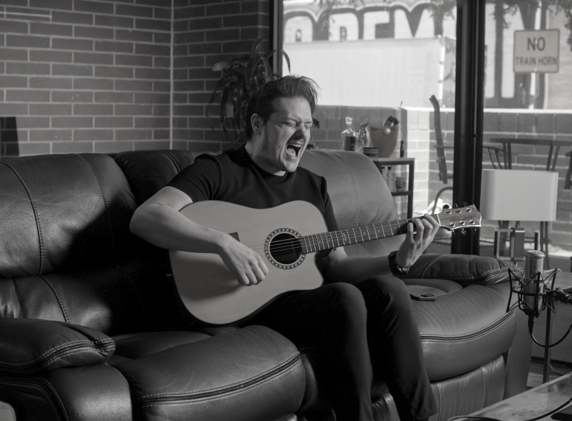
Every once in a while, a song comes along that reminds me why I love writing about rock music. It has the guitars, the voice, and the kind of build that makes you turn it up. But by the time it ends, you realize you have been listening to something much bigger than a performance.
Wade Cota’s “Last Alarm” is that kind of song. Its acoustic opening is warm and intimate, with understated piano beneath a voice that seems to carry a lifetime of hard miles. Then the electric guitars come alive, the rhythm grows heavier, and Cota’s already gritty delivery pushes toward a desperate, almost furious scream. The final retreat into quieter piano leaves you sitting with what you have just heard.
There is a reason for that anger. And there is a man behind it: Captain Scott Leatham of Tempe Fire Medical Rescue, who died of occupational cancer on December 19, 2024, ten days after his 39th birthday.
A Man Patrick Wishes He Had Known Earlier
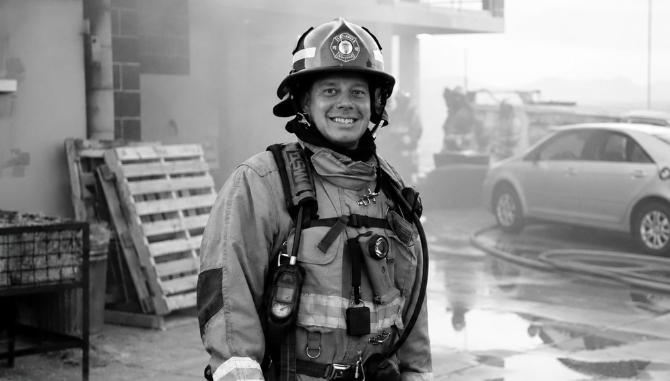
Image: Captain Scott Leatham in firefighting gear. His story is at the heart of Last Alarm.
Scott was a husband, a father of two and an 11-year veteran of the Tempe, Arizona, fire service. Diagnosed in July 2024 with an aggressive cancer, he agreed to let Emmy Award-winning filmmaker Patrick Gramm document his final months. In Scott’s last recorded interview, he expressed a simple hope: if telling his story helped even one person, it would be worth it.
During our Rock The Joint interview, Gramm told me something that stopped me. He had never known the healthy Scott. By the time they met, Scott was seven or eight weeks into treatment, had nearly died from multiple-system organ failure, and was terribly ill. Gramm came to understand the man Scott had been through the people who loved him.
“That’s, like, my only regret,” Gramm told me, explaining that he never met Scott when he was simply living his life as a father, firefighter and member of his community. The outpouring from fellow firefighters, relatives, church and neighbors left him certain that Scott had been deeply loved and respected.
Scott was especially concerned that younger firefighters were not taking occupational cancer seriously enough. Gramm said Scott hoped others would do everything possible to lower their risk. Firefighters train for collapsing roofs and running out of air; the danger that follows them home can be harder to see.
A Voice Built for the Weight of the Story
Gramm had already tackled the subject in his Emmy-winning documentary “Dying to Save You.” But while reviewing Scott’s footage on a morning walk, he began imagining the material as a music video. There was one problem: no song existed that could bear the emotional weight of those images.
He remembered Wade Cota, the Top 5 finalist from the 2019 season of “American Idol.” Gramm had also seen him perform live in Tempe with his wife and remembered the force of his voice. He tracked down a booking contact, sent a text, and the next day Cota was in Gramm’s living room. They agreed that Wade would write the song and Patrick would build the film.
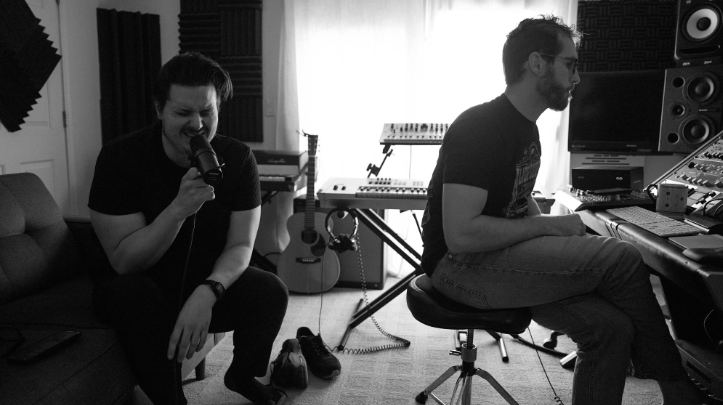
Image: Wade Cota at the microphone during a studio session for Last Alarm.
When I asked Wade what first struck him about Scott, he did not talk about awards or music. It was Scott’s age, the family he left behind, and the cruelty of a life devoted to helping others being cut so short. “If that’s the little way that I can help soothe them is to write a freaking song,” he said, “then damn it, I’m gonna do it.”
How the Song Actually Began
This is where the story of “Last Alarm” becomes even more remarkable than the press materials suggest.
Wade and his songwriting partner, Grammy-nominated producer Austin Moore, drew inspiration from Gramm’s footage and from time spent with Scott’s family and Captain Bill Rini, another firefighter featured in “Dying to Save You.” Wade told me that during a visit to Rini’s home, he spotted a beautiful guitar and asked to play it. The chords he found there became the foundation of the song. He never changed them.
Later, he continued writing on Scott’s own acoustic guitar. Before Scott died, another firefighter had given him the instrument because he wanted to learn to play. After his death, the guitar was entrusted to Wade. It was not used on the finished studio recording, Wade clarified during our interview, but he wrote the song on it and appears with it in the video.
There is something extraordinary about that connection. Scott was an “American Idol” fan. He had watched Wade perform without ever knowing that this same singer would one day hold his guitar and help carry his story to the world. Scott never heard “Last Alarm.” Yet the instrument he hoped to learn to play became part of the song’s creation.
Wade described the writing experience as the easiest song he had ever had to write and, emotionally, the hardest. After meeting the people whose lives Scott had touched, the music poured out. It was no longer an abstract idea about sacrifice; it had faces and voices attached to it.
Why the Ending Had to Be Angry
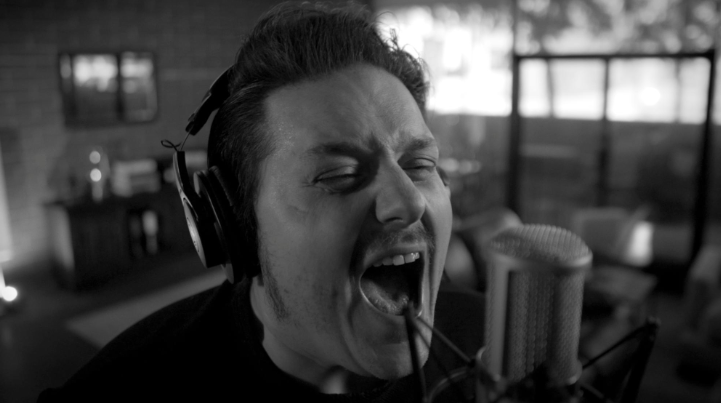
Image: Wade Cota at full force in a performance frame from Last Alarm.
I told Wade how much I loved the musical arc: the beautiful acoustic beginning, the piano, the muscular electric guitars and that raw vocal at the end. His answer revealed one of the most interesting creative tensions behind the record.
Wade said Patrick initially thought the ending might be too hard, even too angry. Wade held his ground. “It needs to be angry,” he told me. “People should be pissed off that this is happening.” The scream was deliberate. It was his response to the brutality of a firefighter losing his life this way, despite everything we now know about the danger.
And here is the astonishing part: Wade had not seen the assembled music video while writing the song. Gramm worked from footage he knew he wanted to use, but did not build the final edit until the music was complete. When he matched the two, the emotions lined up in ways neither man had planned.
Gramm described how Wade’s increasingly desperate calls to “fight” coincide with the firefighter ceremony, ending as the folded flag is presented. He called it visual poetry. Hearing the men explain that alignment made me appreciate the song’s structure even more. The rage is not an oversized rock finish pasted onto a sad story. It is integral to what the film is trying to say.
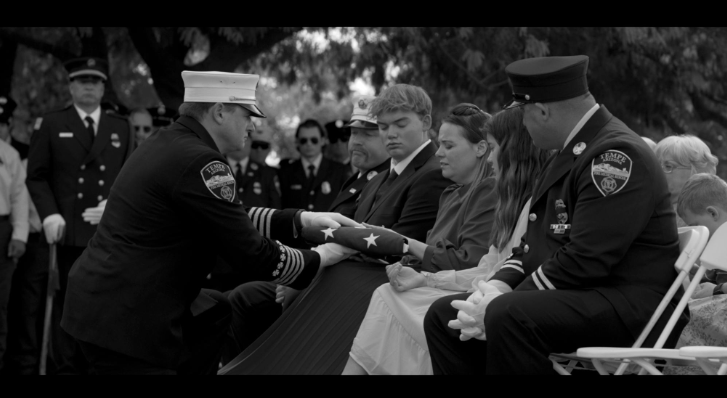
Image: The ceremonial presentation of a folded flag, shown in the Last Alarm film.
The final production was handled by Moore at Marco Polo Studios in Phoenix, Wade confirmed. The recording is polished and powerful, but it has not polished away the feeling.
A Film That Knows When to Hold Back
Some of the footage in “Last Alarm” is extraordinarily intimate. Gramm and his wife, his filming partner, spent months witnessing Scott’s illness and its effect on the people around him. During our conversation, he recalled one eight-and-a-half-hour day in Scott’s bedroom, filming fellow firefighters arriving to say goodbye. He described the experience as both beautiful and soul-crushing.
His challenge in editing was not how to make the footage more devastating. It was how to keep the film watchable enough for people to receive Scott’s message. Gramm told me he could have cut together something nearly unbearable. Instead, he gradually increased the intensity, carefully choosing what the audience would see. That restraint is one of the film’s strengths.
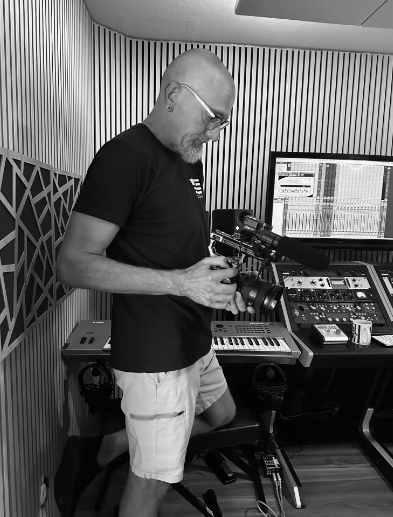
Image: Filmmaker Patrick Gramm working behind the camera in a studio.
The song contains Scott’s last alarm call near the beginning, Gramm revealed. At the very end of the music video, viewers hear a separate, deeply personal recording Scott made for Ashley. Gramm wanted the audience to hear Scott’s own voice. That decision puts the man himself back at the center of a film full of remarkable music and images.
More Than a Song
The danger here is not confined to one department or one family. Research by the National Institute for Occupational Safety and Health has documented higher-than-expected cancer diagnoses and cancer-related deaths among firefighters. For Gramm, the goal is awareness that might influence safer practices, better equipment and public support. For Wade, the project created a new level of respect for first responders and what their families sacrifice.
The press materials state that all advertising revenue generated by the music video will go to Scott’s widow, Ashley. Beyond that commitment, both men made clear in our interview that success is not just a stream count. They want listeners to understand what happened and to care about the people who still face this risk.
As a rock song, “Last Alarm” stands on its own. Cota’s voice is phenomenal; the guitars bite, the piano knows exactly when to step forward, and the arrangement earns every ounce of its power. As a film, it refuses to let a statistic stay a statistic.
But what I will remember is the guitar. A man hoped to learn to play it. He never got the chance. Another musician picked it up and wrote a song that might reach someone Scott could never meet.
Scott Leatham spent his career answering calls for people who needed him. Through Wade Cota’s music and Patrick Gramm’s film, his final wish has another chance to be heard.
And if that story helps save even one life, what a hell of a legacy that would be.
“Last Alarm” is scheduled for public release November 16, 2026, at 8:00 a.m. EST.
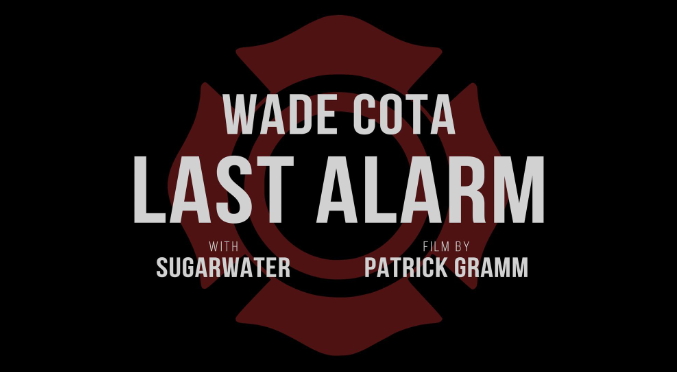
Image: Last Alarm title artwork with Wade Cota, Sugarwater and filmmaker Patrick Gramm.
*
Love what we do? Rock the Joint Magazine is completely free — no paywalls, no ads ruining the vibe — just passionate music journalism for 1,000+ readers a day. If you enjoy hanging out with us, please consider hitting the “Support Us” button and buying us a coffee on Ko-Fi. Even a small donation genuinely helps keep the magazine running, lets us publish more features, and reminds us that people value independent music writing.
You can stream music by Wade Cota here
By Chad Cubberly

JOIN ROCK THE JOINT MAGAZINE ON A JOURNEY FOR THE BEST IN INDEPENDENT MUSIC JOURNALISM – WE COVER ROCK, COUNTRY, JAZZ AND CHRISTIAN MUSIC. LEADING FEATURES, INTERVIEWS, REVIEWS AND EDITORIALS. SUPPORT US ON KO-FI.